Information service of the Pontifical Mission Societies since 1927
Miao (Fides News Agency) — “Manipur has been in turmoil for four years, with new outbreaks of violence reported almost every day. Most of the violence is directed against innocent villagers and women. The situation appears to be worsening by the day, with divisions and polarization deepening. What began as a conflict between two groups has evolved into a multidimensional conflict, with no solution in sight. In this context, we want to raise our voices to God: prayer, alongside concrete solidarity, is a resource to which we can turn.”
This is what Father Felix Anthony, Secretary for Social Communications in the Diocese of Miao, in the northeastern Indian state of Arunachal Pradesh, told Fides News Agency.
The relationship between the Diocese of Miao and the State of Manipur is extremely close, both geographically and institutionally, as well as in terms of humanitarian cooperation. The two lie within a remote macro-region of India that is isolated from the rest of the country and marked by a complex history. The Diocese of Miao, in Arunachal Pradesh, and the Archdiocese of Imphal, which covers the entire state of Manipur, belong to the same Bishops’ Conference of Northeast India. Moreover, many priests, missionaries—particularly the Salesians of Don Bosco—and religious sisters serving in Miao have received their formation or served in educational and theological institutions in Manipur. The bishops of the region work closely together to coordinate pastoral, social and educational initiatives.
Since May 2023, Manipur has been the scene of a bloody ethnic conflict between the Meitei majority and the Kuki tribal minority, with the Naga, the state’s third major ethnic group, subsequently becoming involved as well. The violence has claimed approximately 260 lives, destroyed hundreds of churches and displaced more than 60,000 people within the state. In response to the crisis, the Diocese of Miao has played an active role in providing support: through its social-service arm, Seva Kendra, the local Caritas organization, the diocese has helped collect and deliver humanitarian aid, medicines and essential supplies to camps for displaced people run by the Archdiocese of Imphal.
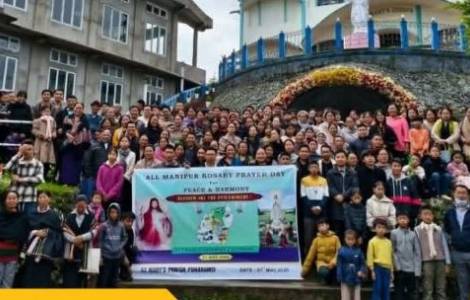
The Bishop of Miao, Salesian George Pallipparambil, is one of the most authoritative voices in northeastern India. He has repeatedly called for an end to the violence in Manipur and promoted reconciliation. The Miao community regularly organizes communal prayer initiatives. Recently, for the feast of Our Lady of the Rosary, the entire diocesan community gathered for an online prayer vigil, placing the resolution of the crisis in Manipur and reconciliation among the Kuki, Meitei and Naga ethnic groups at the heart of their intentions.
The faithful prayed for peace through the online recitation of the Rosary. Representatives of various groups—including young people, priests, religious sisters, men and women—joined the virtual prayer, united in a common appeal for peace in Manipur, Arunachal Pradesh, northeastern India and the whole world.
Bishop George Pallipparambil reminded participants of the spiritual power of the Rosary in the face of evil and conflict. “The Rosary is our powerful weapon against the forces of evil. We do not pray the Rosary only today, but every day, and we should recite it as often as possible, especially during this Month of the Rosary,” he said.
The faithful prayed that, through the intercession and maternal guidance of the Virgin Mary, the peoples of northeastern India may rediscover the path to Christ—a path marked by peace, forgiveness and reconciliation.
In his concluding remarks, Bishop Dennis Panipitchai, SDB, Auxiliary Bishop of Miao, urged the faithful to continue praying for peace in Manipur and Arunachal Pradesh. “The Rosary is a powerful weapon for bringing peace to hearts,” he said, describing it as “a school in which Mary teaches us to contemplate Jesus.”
The situation in Manipur remains extremely critical, with the ethnic conflict continuing to evolve in complex ways and recent spikes in violence adding to the instability. While the hostilities that erupted in May 2023 initially pitted the Meitei majority against the Kuki-Zo tribal minority, tensions have dangerously widened in 2026. In recent weeks, heavy armed clashes and ambushes have involved Kuki and Naga communities—the latter belonging to another major tribal group that had previously remained neutral. In the first half of October 2026, a new wave of shootings in the hill districts of Kamjong, Ukhrul and Kangpokpi left at least nine civilians dead, prompting renewed security concerns. At the institutional level, the state’s current Chief Minister, Yumnam Khemchand Singh, has condemned the violence and ordered a major deployment of security forces to the most sensitive areas.
Amid the ethnic crisis, local rebel groups have called a general strike for 15 October 2026, known as “National Black Day”, in protest against the 1949 annexation of Manipur to India. The strike has further paralyzed the region, where more than 60,000 people remain internally displaced, many still living in precarious conditions in relief camps.
The Archbishop of Imphal, Archbishop Linus Neli, is at the forefront of efforts to mediate the conflict. He has issued a strong appeal to leaders of all three main communities—Meitei, Kuki and Naga—to stop the cycle of revenge and sign a peace agreement. Civil-society organizations and religious leaders are stepping up talks with the local government in an effort to establish channels of dialogue and open humanitarian corridors to support the reconstruction of destroyed villages.
(PA) (Fides News Agency, 15/10/2026)