
Information service of the Pontifical Mission Societies since 1927
UCA News
by Marta Zhao
Rome (Fides News Agency) – In 1998, when Pope John Paul II invited two bishops from the People’s Republic of China to Rome to participate in the Synod on Asia, their seats remained empty. The two invitees, Matthias Duan Yinming and Joseph Xu Zhixuan, were unable to travel to the Eternal City and thus demonstrate, through their physical presence, their communion with the Bishop of Rome.
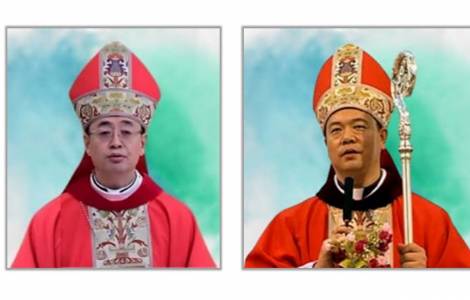
These days, two bishops from the People’s Republic of China – Matthew Zhen Xuebin, Coadjutor Bishop of Beijing, and Joseph Huang Bingzhang, Bishop of Shantou – can be seen in the halls of the Nervi Hall, where a meeting convened by Pope Leo XIV is taking place from 7 to 14 October to mark the tenth anniversary of the Apostolic Exhortation Amoris laetitia. This is a fact worth bearing in mind when objectively assessing the progress made over recent decades in enabling Chinese Catholic bishops to demonstrate their communion with the Bishop of Rome, now Pope Leo XIV.
Pope Leo XIV is reaffirming the goodwill shown towards Chinese bishops by the Bishop of Rome, a gesture also extended by Pope Francis two years ago. At that time, Joseph Yang Yongqiang, Bishop of Hangzhou, and Vincent Zhang Silu, Bishop of Funing/Mindong, sat alongside Pope Francis and spoke with him during the second session of the Synod on Synodality. A few months earlier, in May 2024, Joseph Shen Bin, Bishop of Shanghai, had addressed a conference marking the 100th anniversary of the ‘Concilium Sinense’, organized by the Pontifical Urbaniana University under the auspices of the Dicastery for Evangelization. He also held fraternal exchanges with Cardinal Pietro Parolin, Secretary of State to His Holiness, and Cardinal Luis Antonio Tagle, Pro-Prefect of the Dicastery for Evangelisation.
In 2018, Bishop John Baptist Yang Xiaoting, who attended the Synod on Young People alongside Bishop Joseph Guo Jincai, described their presence in the Paul VI Audience Hall as a “miracle”. Events that were once considered exceptional are now beginning to be common practice.
The meeting convened by Pope Leo XIV is entitled Ten Years after Amoris Laetitia: Proclaiming the Gospel with families today. It brings together the heads of the Eastern Catholic Churches and the presidents of episcopal Conferences. A total of 187 participants are attending.
“I do everything for the sake of the Gospel”
“I do everything for the sake of the Gospel”: Bishop Matthew Zhen Xuebin, Coadjutor Bishop of Beijing, invoked this phrase of St Paul the Apostle following his episcopal ordination on 25 October 2024 in Beitang – the “Northern Church” – the cathedral dedicated to the Saviour.
The letter of approval issued by the body known as the Catholic Bishops’ College of China stated explicitly: “This candidate has been approved by the Pope.”
Matthew Zhen Xuebin was born on 10 May 1970 in Changzhi, a village in China’s Shanxi Province. From 1988 to 1993, he studied at the Philosophical and Theological Seminary in Beijing. From 1993 to 1997, he continued his studies at St John’s University in New York, founded by the Vincentian Fathers, where he earned a licentiate in liturgy.
He was ordained a priest on 25 June 1998 and incardinated in the Diocese of Beijing. From 1998 to 2007, he served as vice-rector of the Beijing Seminary. He subsequently exercised his ministry in several parishes in the city.
Joseph Huang Bingzhang was ordained a bishop in July 2011 without a papal mandate. On 8 September 2018, shortly before the signing of the Provisional Agreement between the Holy See and the People’s Republic of China on the appointment of Chinese bishops, Pope Francis welcomed Bishop Huang into full ecclesial communion, together with six other Chinese bishops previously ordained without a papal mandate.
His official installation as Bishop of Shantou took place on 22 January 2019. The diocese has approximately 140,000 faithful, around 30 priests, a women’s religious congregation dedicated to the Immaculate Heart of Mary, 150 churches and the St Teresa nursery school.
The presence of the two Chinese bishops in Rome bears witness to the concrete participation of the Church in China in a universal ecclesial process. The meeting currently under way at the Vatican also addresses issues relating to family ministry, an area of particular interest in light of Chinese culture and tradition.
The first participation of Chinese bishops in the proceedings of a Synod of Bishops dates back to 2018, the year the Provisional Agreement between the Holy See and the People’s Republic of China on episcopal appointments was signed, (22 September, 2018).
Two weeks after the agreement was signed, at the personal invitation of Pope Francis, John Baptist Yang Xiaoting, Bishop of Yan’an, and Joseph Guo Jincai, Bishop of Chengde, joined bishops from across the universal Church to discuss young people.
Six years later, Joseph Yang Yongqiang and Vincent Zhang Silu, Bishop of Funing/Mindong, took part in the XVI Ordinary General Assembly of the Synod of Bishops, dedicated to the theme “For a Synodal Church: Communion, Participation and Mission”, following their appointment by the Pope.
In 2005, Pope Benedict XVI had invited four Chinese bishops to attend the Synod on the Eucharist: two so-called ‘official’ bishops – Anthony Li Duan of Xi’an and Aloysius Jin Luxian of Shanghai – and two whose status was not recognized by the political authorities, Joseph Wei Jingyi of Qiqihar and Lucas Li Jingfeng of Fengxiang. None of the four, however, was granted permission to travel to Rome.
(Fides News Agency, 8/10/2026)



 ASIA/INDIA - From south India's coastal plains to the Himalayan foothills: the missionary path of Bishop Edward Baretto of Darjeeling
 The Heaven opened, the Bishop’s Mission, and the Grace of being a little flock
 VATICAN - Cardinal Luis Antonio Tagle is the new Dean of the Sacred College of Cardinals
 Pope Leo XIV: Let us celebrate the 100th anniversary of World Mission Sunday with gratitude and generosity
 “Saints have a past and sinners have a future.” Chinese Catholics celebrate Saints Peter and Paul, Patrons of the Church of Rome
 The 2026 General Assembly of the Pontifical Mission Societies begins
 In Malawi, a whole stadium celebrates 100 years of World Mission Sunday: “United in Christ, united in mission”