Information service of the Pontifical Mission Societies since 1927
SMA
by Antonella Prenna
Rome (Fides News Agency) – Father François Marie Hervé du Penhoat has been at the head of the Society of African Missions for almost a year and a half, at a time of profound transformation. After many years as Provincial Superior in Lyon, he was elected Superior General in May 2025, during the Society’s 22nd General Assembly in Rocca di Papa. His new role has brought him into contact with an even more international reality, shaped by different languages and cultures, constant travel and new responsibilities.
In a conversation with Fides News Agency, he discusses the challenges facing a missionary congregation called to rethink its very way of being and how it carries out its mission. The world in which missionaries once set out for territories without Christian communities has changed profoundly. In many parts of Africa, well-established local Churches now exist, and mission is taking on new forms. It is no longer simply a matter of bringing the Gospel to distant lands, but of rediscovering the missionary dimension of every Christian and every community.
From the formation of young missionaries to inculturation, from collaboration between different provinces to the choice of destinations, a number of questions emerge that are central to the SMA today: how can authentic missionaries be formed? How can missionaries live alongside people without merely speaking to them? And how can a missionary vocation be sustained in a world that is increasingly globalized, individualistic and virtual?
Father François’s reflections stem from his personal experience but extend to the broader understanding of mission and the future of a congregation that, despite undergoing a period of change, continues to regard being present alongside people as the heart of its vocation.
“It has been a major change for me. I was used to France, where everything ran relatively smoothly. Now, as Superior General, there are so many challenges to deal with: languages, travelling... One rather frustrating aspect is going somewhere knowing that you will probably never return. It is very different from what I was used to,” the missionary explains.
“Last week I was in England and met a number of people, but I do not think I will go back there, because there are so many places to visit and so little time. In fact, six years is a very short period,” he points out, referring to the length of his mandate.
“One of the challenges we faced when the new team took office was putting the group together. Most of the technical staff members came from the provinces or districts, so, apart from two confreres from the previous Council, everyone was new and came from a different country. We had to learn a new job together with people we did not know. Everything is new, and I feel lucky because we have a good team and get along well.”
How do you view mission in general? Do you notice differences between the time when you began your ministry many years ago and the new communities you have encountered since then?
Yes, I think it is much more difficult today. In the past, I believe, it was easier. I felt a little like one of the last ‘old-school’ missionaries: I went to places where there were neither Christians nor churches.
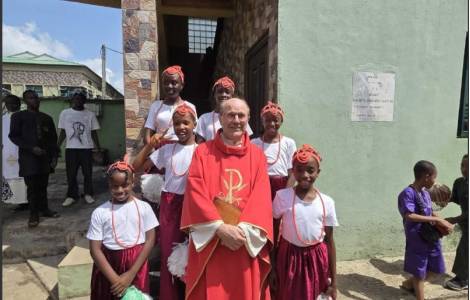
Today, however, there is a diocese, and we are part of it. At one point, I established a new mission area, and it was a privilege to witness people converting to Christianity and, subsequently, the construction of a church. That church grew out of a small community in the villages. It was a truly beautiful experience.
I remember spending a great deal of time in the villages. At 5.30 or 6 in the morning, people would gather for prayer. I saw them kneeling in the chapel at 5.30 a.m., and bear in mind that six months before they were not even Christians. There was something extraordinary about all of this. I felt that we were witnessing a mystery, something concerning the relationship between God and each individual. For me, it was a privileged moment.
But, to return to your question, that period is almost over. Throughout that part of Africa, communities have now been established: there are no longer vast areas without churches or Christians. We have been asked to go to new countries and specific locations. Perhaps, if we go there, we will encounter a similar situation.
I believe we need to rethink mission as a whole and approach it in a new way. When Pope Francis first became Pope, I found the change in perspective rather disconcerting. I was teaching missiology, and in the time of Pope John Paul II the distinction was very clear: there were diocesan priests, and there were missionaries. We were the missionaries.
With Pope Francis, however, the perspective changed: everyone is a missionary; the whole Church is missionary.
Last week in England, wherever I went, I told people: “You must help your parish priest so that he can help you work together.” But your priests are missionaries too: they must leave the parish and go out to meet people. Mission does not concern the priest alone; it involves you as well. That is why priests should encourage you to leave the church building and reach out to others.
Personally, it took me some time to absorb this new dimension. I can see that our own people have not yet fully understood it either. It will probably take a long time. In reality, we need a profound change of mentality, a genuine conversion in our attitude, so that we can become missionaries to others and step out into the open. Encouraging everyone to step out of their comfort zone: this is, in fact, the great challenge facing mission today.
For me, another challenge is standing alongside those who suffer. I believe, however, that our people need more preparation and support to face these situations. At present, we are not doing everything we should for them. And yet I believe that simply being present – being there and staying alongside people – is fundamental to them.
How do you decide where to assign a missionary? Do you tend to send people to their country of origin?
No, we are contrary to this practice. There is a tendency to do so, but we oppose it because I believe it is one of the key aspects of our missionary vocation. This aspect would be lost if everyone were a missionary in their own homeland.
I believe that what the bishop asks of us is precisely to represent something different. We bring something new to the diocese. I remember being told in Nigeria: “You are outsiders to all the disputes and power struggles.”
I was Vicar General in Benin, and the atmosphere around the bishop was almost reminiscent of the court of a medieval city. If you are a foreigner, you bring something different and, I believe, in a sense you can bring peace, provided you carry out your role properly.
How does all this fit into the SMA’s current organizational structure?
The SMA is going through a period of transition. Traditionally, each European country was responsible for a particular African country. The Italians worked mainly in Côte d’Ivoire; the Irish in Nigeria, Ghana and Liberia; and the French in Côte d’Ivoire, Benin and Togo.
Initially, however, the SMA operated internationally and was highly centralized. We then moved to a strongly decentralized system, in which each European province governed a particular country. Each province was almost a small kingdom in its own right. At that time, the General Council’s role was primarily one of authority; everything was organized from Cork, in Ireland, or Lyon, in France. That was how the system worked.
For some forty years now, we have been changing course thanks to the establishment of new provinces and units in Africa. Today we have a mixed system. The provinces are calling for autonomy, but formation involves the whole Society; in the past, however, each province had its own formation system.
There are many issues that we address as a General Council. Over the past year, I believe we have maintained a good balance. When an appointment is being considered, two units discuss the matter and agree to send someone to a particular place, for example, to support the development of the country receiving the missionary.
Perhaps the key point is precisely this: changing, keeping pace with the times and responding to the challenges facing each individual country. Visiting different places allows us to assess the situation and perhaps make different decisions for Nigeria, Togo or other countries.
I believe we have also made progress in terms of collaboration between the units. Historically, a province would independently establish a new mission: the Strasbourg province would go to the United States, the French province to Spain, and so on. It worked somewhat like the monastic tradition, in which one monastery gave rise to others.
Today, however, decisions are made jointly. For example, this year we decided to establish a mission in Chad. It was a new decision, taken by the Plenary Council. We are launching this project, partly for financial reasons.
We are building two new formation houses in Tanzania: one for the second novitiate, or spiritual year, and the other for philosophy studies. In Zambia, meanwhile, we have a house for religious formation.
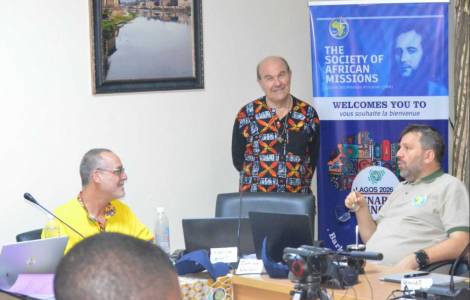
Yesterday, we met with all the SMA leaders from around the world to work together and seek common solutions. In a sense, this is a prophetic calling. A missionary congregation, too, must be prophetic. Therefore, we should be doubly prophetic.
We have missionaries in the Philippines and India. We also have many young people in formation – I believe there are more than 400. This is a major challenge. But how can we form these people into true missionaries? For me, that is the fundamental question.
It is easy to send people all over the world; it is much more difficult to form true missionaries, people who truly desire to proclaim the Gospel. At our last General Assembly, we spoke precisely about missionary zeal.
With regard to formation and inculturation, what do you consider particularly important?
One aspect I came to understand clearly in France is inculturation. I had worked in Africa and had to learn the local culture of the area where I was serving. But I realized that, just as I had done in Africa, my African confreres who come to France must do the same.
This is an essential task for us. At the same time, however, a new challenge arises in the relationship between culture and the proclamation of the Gospel, particularly in light of the broader global culture and, above all, the individualistic culture of our society.
We cannot simply adapt ourselves to this kind of culture. We must build our own Christian culture and, as missionaries, our own missionary culture as well. This is something we lack today.
In the past, when someone joined a missionary Society, there was a particular way of being a missionary. People joined and were shaped by the atmosphere, the environment and the shared experience. Today, something is missing because we lack a point of reference.
How many members does the congregation have?
There are 902 of us. We are not a particularly large congregation.
When I was in France, I tried to make contact with a new missionary movement. Some of its members live out a very intense, daily missionary experience, reaching out particularly to young people on beaches and telling them: “Jesus loves you.” They are wonderful people.
Personally, however, I do not feel comfortable with this approach. I believe our way of acting is to be among people and to live alongside them.
In this sense, our approach runs counter to the new, virtual culture. A part of our lives – indeed, the most important part – should consist of living with people. Inculturation means sharing people’s lives and conveying Christ’s presence through our own lives and through who we are.
Speaking of France, what do you think of Pope Leo XIV’s recent visit?
I was in England and very busy, but I followed the visit. I believe everyone appreciated it, as well as the Pope’s manner and approach: his ability to listen to people and the great attention he showed to everyone, including the sick in Lourdes.
I would say that the response was very, very positive. Even anti-clerical intellectuals had nothing to criticize. No one raised any objections, apart from concerns about the high costs. But he handled it well, responding to the needs of the moment.
It is remarkable how attentive he is. When I was Provincial Superior, I dealt with issues relating to abuse. I therefore paid particular attention to what he did in Lourdes, where he met seven survivors of abuse, spending about fifteen minutes with each of them.
That is a considerable amount of time to set aside in the schedule of a weekend visit. They all felt that they had been listened to – truly listened to.
And what is life like here in the House?
There are about twenty of us living here at present, and we also accommodate students. There was also a community of Indian Franciscan sisters, but they left this year after opening what is effectively a provincial house for Europe in Rome.
We therefore decided not to take in any new students this year. We need to learn to run the house on our own and work out how to do it. The nuns’ presence, in fact, made life much easier.
Of course, we contributed too, but there were many things they took care of without our even realizing it. They managed so many aspects of everyday life.
This is a challenge for me as well. What is the purpose of this house? We do not need such a large building. We need a house in Rome for two or three people: one person to take care of relations with the Vatican and two or three students. That could be enough.
If we decide to keep this house, which also entails considerable costs, we must give it a clear purpose and reason for being.
(Fides News Agency, 9/10/2026)
SMA
SMA