
Information service of the Pontifical Mission Societies since 1927
brics2026.gov.in
by Cosimo Graziani
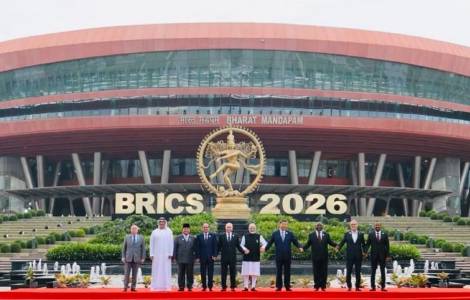
New Delhi (Fides News Agency) – The 18th BRICS summit was held in New Delhi on Saturday, Sept. 13, and Sunday, Sept. 14, with India hosting and chairing the group’s proceedings. The BRICS now brings together countries that account for around 40% of global GDP and half of the world’s population. The summit reaffirmed the group’s longstanding political demands: greater political weight for countries of the Global South and reform of international institutions. The grouping currently comprises 11 members – Brazil, Russia, China, India, South Africa, Egypt, Ethiopia, Iran, the United Arab Emirates, Saudi Arabia and Indonesia – as well as a number of partner countries.
This year’s meeting focused on “building resilience, innovation, cooperation and sustainability”, themes reflected in the final declaration adopted on Saturday.
The document goes beyond the group’s general call for multilateralism and diplomatic solutions to international disputes, addressing a number of specific issues. The war involving Iran was among them. Reuters reported that the declaration expressed “deep concern over the continuing escalation of tensions” and called for restraint to “avoid actions that could further worsen the situation”.
On the Middle East, the document also addressed the conflict in Palestine, expressing “strong opposition” to the displacement of the population from its land and to any demographic or geographical changes to the Palestinian territories.
The use of sanctions as a political and economic tool was described as contrary to international law, damaging to trade between countries and to developing economies, and inconsistent with the United Nations Charter. The reference was to the sanctions imposed by the United States on Iran in recent months, as well as those introduced in the context of the war between Russia and Ukraine.
The conflict in Ukraine, however, received only limited attention in the declaration. As Al Jazeera noted, the document called simply for a resolution of the war based on “dialogue, engagement and diplomacy”.
Although the organization professes unity of purpose (Indian Prime Minister Narendra Modi sought to highlight this when he emphasized that the statement had been approved unanimously), there remain unresolved issues that cast doubt on the group’s cohesion. The most obvious of these is the presence of countries with differing international interests and alliances. The positions of the Middle Eastern members illustrate the difficulty. Iran, the United Arab Emirates and Saudi Arabia have taken different positions on the conflict in the Persian Gulf.
During a bilateral meeting with Russian President Vladimir Putin, Modi also told his counterpart that a solution to the conflict in Ukraine must be found. Such details, which were not highlighted in the official declarations, raise questions about whether the BRICS can eventually develop into a genuine platform for advancing the interests of all its members.
For the time being, however, the BRICS remains a significant alternative platform for a number of countries, particularly in Africa. The continent has three BRICS members and two partner countries, Nigeria and Uganda. Each sees the organization as an opportunity to advance its own political priorities.
Ethiopia is perhaps the clearest example. According to the Ethiopian News Agency, Prime Minister Abiy Ahmed said the final declaration supports his country’s membership of the World Trade Organization (WTO). Abiy also said Ethiopia was ready to host a regional office of the New Development Bank (NDB), the institution established by the BRICS in 2014 as an alternative to the World Bank, although it has so far fallen short of fully fulfilling that ambition.
South African President Cyril Ramaphosa focused this year on the regulation of artificial intelligence. In particular, he called for the group to establish an international body capable of overseeing AI independently and on a scientific basis, according to the African news outlet Scrolla.
Ramaphosa highlighted both the opportunities and the risks associated with the technology. Tackling inequality and poverty, and advancing medicine, education, science and agriculture were among the areas he identified as having potentially positive results. At the same time, he warned of the possibility that AI could eventually be used to develop biological weapons or carry out cyberattacks.
As for the two African partner countries, Nigeria’s delegation was led by Vice President Kashim Shettima, while Uganda’s was headed by Vice President Jessica Alupo.
During the summit, Shettima focused first on reforming international governance, particularly reform of the United Nations Security Council, and then on the role the organization can play for African countries.
For Nigeria, the BRICS is a platform for strengthening trade, investment and global governance. Statements from the Ugandan delegation pointed in the same direction. Its members stressed the potential role of the NDB, including in strengthening trade relations with the group’s larger economies, particularly China and India.
It remains to be seen whether these objectives will be pursued by the organization and whether the African partner countries will decide to join as full members. If that happens, with five African members, the BRICS could develop an “African pillar” capable of influencing the organization’s future direction.
(Fides News Agency, 19/9/2026)



 U.S. Secretary of State Rubio’s South American tour: the fight against drug trafficking and the implementation of the “Donroe Doctrine”
 Somalia between security transition and terrorism
 ASIA/MALAYSIA - Malaysian Ambassador Assan: "Respect for international law, and the protection of human dignity is the path to peace in the Middle East and Southeast Asia"
 ASIA/NORTH KOREA - Katharina Zellweger: "Sanctions against North Korea need to be reconsidered and peace diplomacy is needed"
 Litoměřice: New commemorations for victims of anti-German massacres of 1945 during the “Jubilee of Reconciliation”
 The feast of the Transfiguration of the Lord Jesus in a world disfigured by war
 What lies behind the diplomatic clash between Argentina and Brazil
 Archbishop Nwachukwu’s “compass” for Catholic communicators: “You are disciples before being influencers”