
Information service of the Pontifical Mission Societies since 1927
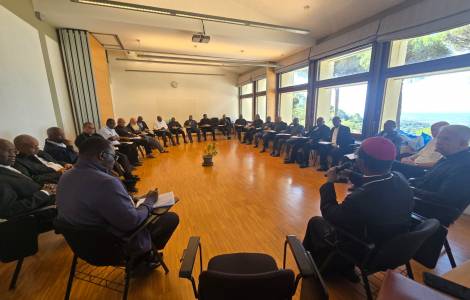
Photo:Marco Sungsu Kim
Nemi (Fides News Agency) – There is a “missionary mandate” inherent in Jesus’ call to his disciples, a mandate that continues to challenge every new “Successor of the Apostles” today. A mandate that must be followed as a ‘guiding principle’ to inspire the choices, initiatives and reforms that every Bishop is called to undertake in the service of the People of God in his diocese.
This is the central theme of the formation Course for Bishops currently being held in Nemi, in the Castelli Romani area. The Course is promoted by the Dicastery for Evangelization (Section for First Evangelization and New Particular Churches), with the support and contribution of the pontifical foundation “Aid to the Church in Need.”
The Course is being held at the “Ad Gentes” Centre, a residence of the priests of the Society of the Divine Word (Verbites). Twenty-one Bishops from English-speaking African countries are taking part in the sessions of work and shared reflection. They received episcopal ordination between 1999 and 2022.
Information gathered by Fides confirms the experimental and innovative character of the initiative promoted by the missionary Dicastery, an approach that can be seen in the “flexible” way in which the program is being conducted. As the days have progressed, the Course has taken on the character of an “open construction site”, an interactive laboratory in which the agenda is continually redirected and reshaped, step by step, also in response to the questions and concerns raised by the participating Bishops.
Archbishop Nwachukwu: the ministry of the Bishop is a “missionary mandate”
At the beginning of the course, the participants chose “the mission and identity” of the Church and of Bishops today as the most relevant theme among the numerous thematic units proposed as alternatives.
This choice was also influenced by the broad-ranging address delivered on Monday, 14 September, by Archbishop Fortunatus Nwachukwu, Secretary of the Dicastery for Evangelization. His presentation focused on the themes of exclusion, communion and episcopal identity.
In his intervention, Archbishop Nwachukwu addressed what he called one of the most delicate issues facing bishops worldwide: the exclusion of those “who are considered or perceived as different and therefore treated as though they do not belong to the community”. This dynamic, he said, underlies both the caste system in parts of Asia and the ethnic exclusivism in Africa, which he described bluntly as “the beast called tribalism”.
The many forms of exclusion within the ecclesial context, the Archbishop explained, share a common denominator: “the exclusion of the other person because that person is considered or perceived as different”.
Archbishop Nwachukwu directly linked these dynamics of exclusion to the exercise of episcopal ministry, insisting that communion must remain a defining mark of a Bishop.
The call of Jesus to his disciples, the Nigerian Archbishop recalled, was first and foremost a missionary mandate rather than a managerial one: “Jesus did not call his disciples at the beginning to become pastors, to become shepherds. Mark 1:17 is very clear: ‘As he was passing by the clear Sea of Galilee, he saw Simon and his brother Andrew. They were fishermen casting their nets, and he called them.’ He did not say to them: ‘Come, follow me, and I will make you shepherds.’ He said: ‘I will make you fishers of men.’ This was the call of Jesus to the disciples: to become fishers of men. That is the missionary mandate.”
Called to defeat the “beast of tribalism”
In his address, Archbishop Nwachukwu stressed that communion should never be mistaken for enforced uniformity within a diocese.
“Harmony does not remove the differences, it brings them to form the beauty of choral voices.”
These criteria, he noted, should also be kept in mind in the processes of episcopal appointment, an area falling under the particular competence of the missionary Dicastery.
“Any Bishop who does represent communion, who becomes an agent of division, is living against his identity as a pastor,” he told the assembly, before addressing the new Bishops directly:
“We are looking up to you to help us destroy this beast, this beast that is called tribalism. We want to be able to select the very best candidates to become Bishops, not the person who comes from one ethnic group or another.”
Turning to the theology of priestly identity,the Archbishop reminded the participants that, according to the Letter to the Hebrews, Christ’s priesthood is patterned on that of Melchizedek, a figure without tribal or family lineage: “He had no father. He had no mother. He had no family descent, no human ancestry, but he came as a son of the Most High God.” All Catholic Bishops, he continued, are called to be “priests according to the order of Melchizedek”.
Archbishop Nwachukwu also devoted part of his address to the physical and emotional demands of episcopal ministry. “Taking care of your health, taking some rest,” he said, “is not a luxury for the priest. And it is not a luxury for a Bishop either. It is a necessity. It is something we learn from Jesus.”
Practical paths for fulfilling the Bishops’ “missionary mandate”
After the first session, the Course moved into its operational phase, readjusted in line with the thematic choice indicated by the Bishops themselves.
On the first day, the Bishops were asked to assess, in concrete terms, whether in their own experience the missionary mandate is truly perceived and lived as a guiding principle in the exercise of their episcopal ministry, and whether this awareness can be found in any document outlining the pastoral planning and vision of diocesan life.
A parallel diagnostic exercise was carried out on the bishop's exercise of the three “munera” (offices) of the episcopal ministry: teaching (magisterium), sanctifying, and governing.
The purpose of the course, which gradually emerged throughout the sessions, is to help each Bishop articulate his own pastoral vision for his diocese, and subsequently, on the basis of the resources currently available, to drafting a strategic pastoral plan with concrete steps to reach that vision, that can contribute to fulfilling the missionary mandate of each diocesan community, taking into account its particular context, shortcomings and priorities.
The insights and discernment methodologies proposed by those leading the course—including Professor Peter Beer and Father Olivier Soma of the Institute of Anthropology of the Pontifical Gregorian University, and Father Marco Sungsu Kim, an Official of the Dicastery for Evangelization and professor at the same university’s Institute of Psychology—have helped the Bishops identify the “strengths” and weaknesses, opportunities and risks that characterize the condition, history and present circumstances of the ecclesial communities entrusted to their pastoral care.
These aspects are also being assessed in relation to the different members and components of the ecclesial community: priests, religious men and women, families, young people, children and the elderly.
The diagnostic and comparative work carried out so far provides the basis for seeking to foster pastoral choices, proposals and programs inspired by the desire to see the “missionary potential” of the various diocesan communities flourish.
This objective is at the heart of the work being undertaken by the Bishops during the final sessions of the formation course, which will continue until Saturday, 19 September.
It is an endeavour to be embraced with a realistic awareness of available resources, as well as urgent needs, vulnerabilities and all those unforeseen circumstances that can always, freely and unexpectedly, emerge in the ordinary life of the Church.
(GV) (Fides News Agency, 17/9/2026)



 At the Course for Newly Appointed Bishops, practical tools for missionary communion with the Successor of Peter were presented
 The Church of the Sheaves: a missionary perspective presented to Newly Ordained Bishops
 EUROPE/ROMANIA - Pontifical Society of the Holy Childhood: Jesus’ “torch” at the heart of missionary summer Camps
 POPE IN FRANCE/V - The (silent) mission of Lourdes: “God’s charity does not heal those who have no wounds”
 The Centenary of the consecration of Six Chinese Bishops and the Provisional Agreement between the Holy See and the People’s Republic of China
 One hundred years later. The long journey of China’s first Bishops to receive Episcopal Ordination from the Successor of Peter
 AFRICA/MALAWI - Course for minor and major seminary formators promoted by the Pontifical Mission Societies