
Information service of the Pontifical Mission Societies since 1927
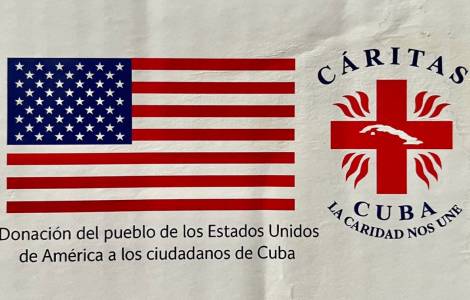
Havana (Fides News Agency) – New U.S. sanctions against Cuba are placing additional pressure on a population already grappling with one of the country's most severe economic and social crises in recent decades.
On July 13, the U.S. State Department announced new restrictions targeting Cuba's Ministry of Tourism and nine other state entities operating in sectors including foreign trade, fuel and public services.
The latest measures, published by the Office of Foreign Assets Control (OFAC), affect the tourism industry, one of the island's main economic driving forces, at a particularly critical time for Cuba's energy system, which continues to struggle with fuel shortages and prolonged blackouts.
The consequences are being felt in the daily lives of Cubans, with growing difficulties in accessing food and medicines, the deterioration of essential public services and increasing social uncertainty. The energy crisis is especially affecting the most vulnerable families, making it more difficult to preserve food, obtain water and carry out everyday activities.
For months, leading figures of the Cuban Church have been drawing attention to the seriousness of the country's crisis. Earlier this year, the Cuban bishops called for "paths of dialogue, shared responsibility and solutions capable of restoring hope," emphasizing the importance of fraternity and the common good (see Fides, 17/4/2026).
In their pastoral letter to the Cuban people, the bishops reaffirmed that the Church "will continue to accompany this people whom we love," particularly the poor, the sick, families, prisoners and all those living in situations of greater vulnerability. They also expressed their willingness, if requested, "to help lower the level of hostility between the parties and create spaces for fruitful cooperation for the sake of the common good."
At the same time, Caritas Cuba continues its practical commitment to supporting those in need. Through the organization's social media channels, Archbishop Dionisio Guillermo García Ibáñez of Santiago de Cuba, President of Caritas Cuba, described the distribution of humanitarian aid sent from the United States to families affected by Hurricane Melissa, which struck the eastern provinces of the island in 2025.
"More than 50 containers of humanitarian assistance passed through the port and the airport," the Archbishop said. "This does not solve all the problems, but at least around 8,000 families have benefited, and that is already something."
He also clarified that the funds announced—an initial three million dollars, later increased by a further six million—were not transferred directly to Caritas Cuba as cash, but were provided in the form of relief supplies distributed through the Church's network.
The aid reached the eastern dioceses of Guantánamo, Holguín, Bayamo-Manzanillo and Santiago de Cuba, where thousands of families received food, hygiene products and other essential goods.
Archbishop García Ibáñez stressed, however, that humanitarian assistance alone cannot resolve the country's deep-rooted problems. "So many people are asking for help," he said. "And the assistance available is simply not enough to meet everyone's needs."
He also emphasized that Caritas makes no political or religious distinctions when providing assistance. "Caritas does not ask which country the aid comes from," he said. "It simply recognizes that help has been offered, and we receive it in order to distribute it."
Priests, volunteers and Catholic communities have taken part in delivering the relief supplies, reaching even remote rural areas that are difficult to access. According to the Archbishop, this experience demonstrates that cooperation in response to human suffering remains possible despite profound political differences.
As Cuba continues to face difficulties, he encouraged the faithful to remain united in faith and to continue seeking paths of justice and fraternity.
"In these difficult times we are living through," he said, "let us keep the Gospel in our minds, upon our foreheads and before our eyes." (LGR) (Fides News Agency, 15/7/2026)



 THE CHURCH OF THE SHEAVES CONFERENCE - Listening the Continents: Gifts, Challenges and New Missionary Pathways
 "Gift exchange between the Churches requires conversion": Fr. Stan Chu Ilo on the "Church of the Sheaves"
 Egypt, Sudan, Eritrea and Somalia meet to discuss tensions and unresolved issues in the Horn of Africa
 United States lifts sanctions on Eritrea
 AFRICA/NIGER - Sanctions against coup plotters extended: “The people of Niger are prepared to sacrifice their economy for nationalist pride”
 To use AI wisely, first know what you want to preserve, G20 Interfaith forum highlights
 AMERICA/UNITED STATES - At the "G20 Interfaith Forum" Apostolic Nuncio Caccia points out that technologies and innovations "do not tell us what the good is”