
Information service of the Pontifical Mission Societies since 1927
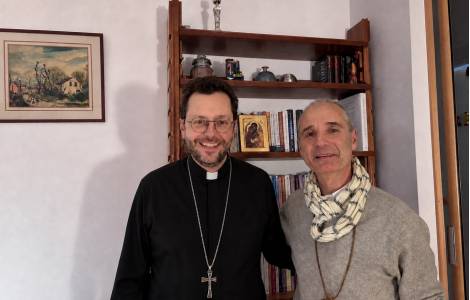
Photo Marie-Lucile Kubacki
by Marie-Lucile Kubacki
Rome (Fides News Agency) - At the school of the Acts of the Apostles, Cardinals Jean-Paul Vesco, Archbishop of Algiers, and Giorgio Marengo, Apostolic Prefect of Ulan Bator, agreed to revisit their experience in Algeria and Mongolia for Fides. Between the Sahara Desert and the Gobi steppe, they describe a mission understood not as activism but as a humble and hope-filled presence, called to proclaim the Gospel in the heart of societies that have not been shaped by Christianity.
In his letter to the cardinals in April, Pope Leo XIV spoke of the "need to relaunch" the Apostolic Exhortation Evangelii Gaudium, regarding the mission of the Church. What does the word “mission” mean to you?
Cardinal Jean-Paul Vesco: For me, the word "mission" first of all sounds like a question: "Why are we here? Why do we stay? What do we want to experience?" I believe this question of "why" is more fruitful than that of "how."
Living in a country where our Church is a minority and legally limited, I have learned that mission is not measured by the quantity of things we do, nor by the visibility of our initiatives, but by the truth of our presence and the quality of our hope.
I often compare our Church to a person with a disability: from the outside, one sees above all what they cannot do; yet they know the cost of what they are able to do. Likewise, mission is not a performance, but a fidelity. The essential is not conveyed primarily through words. We preach the crucified Messiah through who we are, through the way we live relationships while respecting the faith of others. For me, mission consists in allowing our hope to shine through, often discreetly, almost fragilely...
Cardinal Giorgio Marengo: When I hear the word "mission," especially in the light of Evangelii Gaudium, I immediately think of a relationship: the one between the One who sends and the one who is sent. The noun “mission” comes from the Latin verb mittere, to send. It presupposes a living relationship between the one who sends and the one who is sent. It is not: “do me this errand, go deliver this book”; it is something different. Mission is experienced at a profound level, where we give ourselves; otherwise, we risk remaining on the surface, focusing on “doing” while neglecting “being.” In a context like Mongolia, where explicit proclamation is regulated and where the Church is very small, mission takes on the face of discretion and proximity. I often quote a Mongolian catechist who once said that, in the beginning, the Church did not send boxes of books to Mongolia—it sent people. Mission is lived through this humble and relational presence that allows Christ to reach hearts through very simple human mediations.
You both live in countries marked by vast deserts—the Sahara or the Gobi. How has this experience shaped your understanding of the mission?
Cardinal Jean-Paul Vesco: In Algeria, most of the country is indeed desert. Yet 80% of the population lives on 20% of the territory: the desert is immense, but few people live there. When I arrived in the early 2000s, I spent a year and a half in Béni-Abbès, where Charles de Foucauld founded his first hermitage, to learn Arabic. In a certain sense, it was he who brought me to Algeria. There, I truly experienced the desert: its immensity, encounters with nomads... I believe it was the happiest year of my life. It is my lost paradise. When I was elected prior of the Dominican Province of France and had to return to France within twenty-four hours, while I was vicar general of the diocese of Oran, I went through an existential crisis. One sign was that I could no longer pray to Charles de Foucauld, whom I had left in Algeria: I felt I had lost him.
One day, in Paris, I entered the church of Saint-Augustin, precisely where he had converted. Rereading the prayer of abandonment, everything became peaceful within me: I understood that I could be happy again wherever I was, in Paris or elsewhere, with Charles de Foucauld. In the desert, one needs a guide. I walked a lot with a nomadic friend whom I struggled to keep up with, and I learned the difference between walking in someone’s tracks and walking in their footsteps. When I placed my feet exactly where he placed his, I felt I shared his energy. I told myself: following Christ and walking in His footsteps are not the same thing. For me, mission means gradually learning to walk in His footsteps rather than merely following His trail.
Cardinal Giorgio Marengo: When I became bishop, because the Church in Mongolia is still an Apostolic Prefecture rather than a diocese, I received the title of an ancient diocese that no longer exists: Castra Severiana, in Algeria. I was happy to be linked to that part of the world, to the desert, and to Charles de Foucauld. I did not live in the desert, but I spent fourteen years in a region of Mongolia very close to the Gobi Desert, the largest cold desert in the world. It was there that Teilhard de Chardin conducted his studies and wrote his meditation "The Mass on the World." I went there often for visits and exploration. For me, the desert is above all the experience of emptiness: the immeasurable expanse of space. When I find myself in the middle of the desert, I feel invited to move to a higher level, because the rarity of relationships makes everything carry more weight
One can have conversations that are more difficult to have in the city, because everyone opens up more. Immensity and intimacy are linked. One perceives one’s own smallness and, paradoxically, the shadows of morning and evening are very long, because the sun rises and sets very low on the horizon. As if we were called to something greater than what we imagine. This shapes my understanding of mission: less as a multiplicity of initiatives and more as a few very dense relationships, in that emptiness that makes everything more precious.
Today you both live in large capitals. How does the city change the way mission is lived compared to the desert?
Cardinal Jean-Paul Vesco: For me, the desert is in the city. I experienced the oasis of Beni-Abbès as a place of extremely strong social life, where one is always in relationship. In Oran it is already different, and the larger the city, the more it becomes a desert for me: people are more isolated, it is harder to enter into relationship. Being a Christian in a Muslim society is much easier in Béni-Abbès than in Algiers. Look at the experience of René Voillaume, founder of the Little Brothers of Foucauld. Wanting to follow the example of Charles de Foucauld, he went to El Abiodh Sidi Cheikh in the desert and founded a monastery there. But after the war, the brothers understood that the desert is in the city, where poverty is found, and the Foucauld family made a complete shift in spirituality. Mission, for us, then consists in inhabiting these “urban deserts,” made up of loneliness and relational poverty.
Cardinal Giorgio Marengo: For me, it is easier to be in relationship with God in the desert than in the city. This does not mean it is impossible, but in the desert, one is helped by the landscape and the context. One is naturally more inclined to reflect, whereas in the city one is distracted. Cities are places of great loneliness, but often it is a negative loneliness, in the midst of the crowd, whereas in the desert one can experience a positive solitude. Ulaanbaatar, for example, is a very congested city. After the 2000s, it experienced a demographic explosion: half of the country’s population is now concentrated in a limited space, while continuing to think in a nomadic way. The challenges of coexistence are great. I am convinced that we need spaces of silence in the heart of cities, opportunities to listen to a word of wisdom. The Buddhist monasteries scattered throughout the capital are places of deep reflection for people. In the Church, we want our parishes also to be places of peace and encounter with God and with one another. This is, in my view, the primary vocation of parishes in today’s cities.
In your Countries, there is no room for proselytism, and the Churches live under strong legal and cultural constraints. How do these limits redefine mission?
Cardinal Jean-Paul Vesco: When people say to me, "You are limited," it is often meant negatively, but I do not see it that way. Let me give two examples. The first is classical ballet dancers. They seem limitless in their grace and freedom, yet this is achieved through immense discipline within strict constraints. The second is that of the people with disabilities that I mentioned earlier. For me, these two examples are linked. In my mission of evangelization, is there perhaps something essential that I cannot do in Algeria? Ultimately, very little! We preach through what we are and through our hope.
Cardinal Giorgio Marengo: I agree. Limits help us remain in contact with what is essential. When we think we can do everything, we risk getting lost and exhausted in endless activities.
Paradoxically, living the faith as a minority under external constraints can become an exercise in greater freedom. It pushes us toward what truly matters. Legal and cultural constraints become an indirect help in reaching what truly matters.
But can one still speak of mission when explicit proclamation is limited and everything must be lived with great discretion?
Cardinal Jean-Paul Vesco: I cannot reduce mission to an explicit/implicit dialectic. What I know is that I speak much more about God in Algeria than in Europe, because people ask me about Him far more, constantly. The deepest question for me is that of the truth I recognize in the faith of the other.
I think of Pierre Claverie's quote: "I am a believer, I believe there is a God, but I do not claim to possess that God... One does not possess God. One does not possess the truth, and I need the truth of others."
In my concrete experience, discreet means less visible, but also respectful. Our presence is discreet because it respects the voice of the other. Discretion can be a sign of respect, and realism: not asking too many questions, the ones that would break a relationship of trust that has just begun. I think of my first Christmas in Algeria: no outward signs in the streets, yet in our communities a very strong joy, which many still long for. When I returned to France, I said to myself: finally, a traditional Christmas! And yet, I missed the Algerian Christmas, which is incomparable.
Some often criticize us for doing social works without speaking about Christ. We do not forbid ourselves from doing so. I like this phrase of Desmond Tutu: We do not forbid ourselves. I "My life is the Gospel that many people will read." It is not about speaking of Him incessantly, but about making Him visible through our lives. And it is in the question that arises in the other—“why are you here?”—that, I believe, a great missionary strength lies.
Cardinal Giorgio Marengo: I know this quote from Pierre Claverie well, whom I greatly admire. Every year we reflect with the missionaries on the fact that mission must be lived at a deep level, by giving a part of ourselves; otherwise, we risk remaining on the surface, "doing" while neglecting "being." Does it make sense to talk about mission when proclamation is so limited? The answer is yes, as Pope Francis explained in Evangelii Gaudium. Mission is not primarily an external action, but a humble and relational presence, driven by the joy of the Gospel. In the West, I have sometimes observed that people willingly embrace development projects, but get irritated when one says: "We are here for Christ." What matters is to return to this relationship with Christ. As one of our catechists, Rufina, said: "The Church sent people, not packages of books." If mission consisted only in spreading a message, it would be enough to send an SMS to everyone. But mission is far more beautiful: it is a living relationship with Christ, who takes us as we are and introduces us into a circulation of love, joy, and fullness.
In Europe, faith has shaped cathedrals; in Mongolia, nomads live in lightweight structures like gers. What forms of Church seem most suited to mission today?
Cardinal Jean-Paul Vesco: I think of Brother Roger Schutz, the founder of Taizé. At the beginning, the brothers gathered in the small Romanesque chapel of the village. Then, mysteriously, young people arrived, and an architect brother began to build a concrete church. One day, Brother Roger came to see the work and left furious, because he felt everything had become rigid. But a few weeks before Easter, the brothers realized the church was too small. The architect brother said: “There is only one thing to do: tear down the façade.” Since then, the initial stone structure has remained, accompanied by a modular part. This is what Brother Roger called the “dynamics of the provisional.” In Algeria, our relationship to place is particular: the first evangelization took place before Saint Augustine, then there was Islamization and colonization. Most of the churches that existed are in ruins or have become mosques. We live among traces of heritage and present fragility. Both dynamics—the stone and the tent—are important. Architecture is also a way of existing; it is a form of power. When one builds a cathedral, inevitably there is also the ego of those who built it. And then there is transcendence, there is beauty, and that beauty supports prayer. But what is right and what is not? It is a constant discernment.
Cardinal Giorgio Marengo: For young Churches, it is important to look to societies where the Christian faith has shaped art, music, and sacred architecture. One of the effects of evangelization is that the encounter with Christ shapes not only the lives of individuals, but also a way of life, political choices, and artistic choices. At the same time, I appreciate the idea of “provisionality” and lightness, typical of Mongolian nomadic culture, with its frugality: not spending too much money to maintain buildings. The risk for us missionaries is to arrive and immediately start building things. We come from contexts where the Church is also a physical place, and sometimes we build buildings first, thinking the community will come afterward. In Mongolia, we are 64 missionaries from 29 different nationalities: each carries within them the model of Church from their own country and sometimes wishes to reproduce it. The desire to build beautiful churches comes from a very good intention. But for me, it remains an open question: how to articulate lightness and the provisional, very much in tune with Mongolian culture, with the positive and legitimate dimension of a stable place of worship? Perhaps we are called to invent hybrid forms.
Final question: you both live in Churches that are still at their beginnings, even though both are marked by an ancient presence. How can the Church of the origins, that of the Acts of the Apostles, be a source of inspiration?
Cardinal Jean-Paul Vesco: It is true that our Church resembles the early Church of the Acts of the Apostles, and recognizing this supports us greatly. Like the primitive Church, we aspire to be of one heart and one soul; and like it, we are marked by divisions, conflicts, lack of trust, and jealousy. Like it, we regularly have the impression of having to start again from scratch and rebuild, and we perceive in a much more concrete and embodied way the difficulties that are heard both in the Acts of the Apostles and in Paul’s letters. As in the time of the very first Church, we marvel at what the Spirit can do in lives in ways that are humanly inexplicable. And at the same time, we see the Divider at work within our community. Among the very small number of Algerian Christians in our Church, four have died in the last three years, including one of our two seminarians, received as a gift from God. Two of those baptized at Easter 2025 went to heaven within six months of their baptism, and another was seriously injured in an unlikely domestic accident two days after requesting baptism. It is undoubtedly the grace of beginnings: living firsthand these trials of the Evil One and also the strength of the breath of the Spirit.
During the Holy Father’s visit last April, I had hoped to present to him a smiling, sunlit Algeria. Instead, severe weather destroyed much of what we had prepared. At first I was disappointed. Then I realized that what had been revealed was not a postcard image, but a small Church with a burning heart, struggling against wind and tide, that revealed itself in truth.
Cardinal Giorgio Marengo: In Mongolia, we often refer to the Acts of the Apostles as our inspiration. There we find our daily reality described, with its lights and shadows, and from this we draw confidence and hope. We feel strongly the responsibility of accompanying the first generation of Christians, who have much to give us, with the freshness of their adherence in faith. In particular, we are interested in the dynamic, witnessed in the Acts, of proclaiming the Gospel to the non-Jewish world.
In those early stages of the nascent Church, the conviction matured that the Gospel was for everyone, and therefore had to be addressed also to peoples not directly linked to the experience of Israel—as happens for us in encountering the religious traditions of Asia. At the school of the Acts, we feel called to “whisper the Gospel to the heart of Mongolia,” through a simple and discreet witness that blossoms in relationships of authentic fraternity. (Fides News Agency, 24/6/2026)



 THE CHURCH OF THE SHEAVES CONFERENCE - Listening the Continents: Gifts, Challenges and New Missionary Pathways
 "Gift exchange between the Churches requires conversion": Fr. Stan Chu Ilo on the "Church of the Sheaves"
 Bishop Martinelli at the Inter-Christian Symposium in Thessaloniki: Migrants have made the Arabian Peninsula a “Laboratory of an Intercultural Church”
 EUROPE/HUNGARY - Message of the annual gathering of the Pontifical Society of the Holy Childhood: Different yet united in the love of Christ
 VATICAN - Cardinal Luis Antonio Tagle is the new Dean of the Sacred College of Cardinals
 “The Lord is my Shepherd”: Cardinal John Tong’s autobiography, a sign of gratitude for a journey of joy and hope
 ASIA/SOUTH KOREA - Catholic Culture Fair in Seoul serves as a “trial run” ahead of World Youth Day 2027
 The blood-stained Breviary and other "Family Memories" of Father Amédée Benoît
 Mission beyond the illusions of efficiency: following in the footsteps of Venerable Little Sister Magdeleine of Jesus
 Fulton J. Sheen proclaimed Blessed. Cardinal Tagle: “Blessed is the earthen vessel that draws power from Jesus”