Information service of the Pontifical Mission Societies since 1927
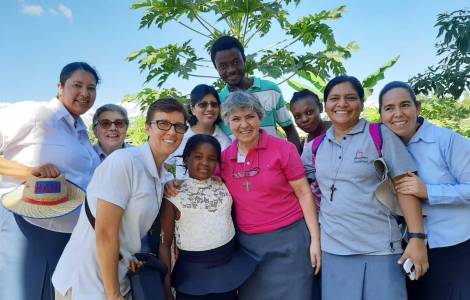
Mercedarias Misioneras de Barcelona
Barahona (Fides News Agency) – The Inter-congregational Missionary Community (CIM) was founded in Haiti in 2010 at the initiative of the Latin American Conference of Women Religious (CLAR) and was later organized by the Ecuadorian Conference of Religious (CER) in response to the devastating earthquake that struck the country. The Community currently carries out its pastoral work in Barahona, in the Dominican Republic. Its presence is situated within a context marked by structural poverty, Haitian migration, and the reality of the ‘bateyes’, agricultural settlements characterized by high social vulnerability. A distinctive element of this presence is its inter-congregational nature: the CIM was born from the collaboration of religious sisters from different congregations, united by a single missionary zeal.
Throughout its history, more than ten religious congregations have participated in this shared experience. This communion of charisms represents a concrete sign of unity in diversity and a significant ecclesial presence in the human and social peripheries, an expression of the richness of consecrated life in co-responsibility and shared service. It is an innovative and profoundly ecclesial missionary experience. The CIM is made up of the Comboni Missionaries, the Catholic Teachers of the Sacred Heart of Jesus, and the Mercedarian Missionaries of Barcelona, who work together on a shared project. Among them is Sister Rosa María del Socorro López Castañeda, a Comboni missionary with extensive experience in border areas. Her testimony, shared by her congregation, was shared with Fides News Agency through the Pontifical Mission Societies of Spain.
Originally from Mexico, the nun explains that her journey is closely linked to the evolution of the CIM, of which she was previously a member in Haiti. There, for seven years, she carried out pastoral work in contexts of extreme poverty and human mobility in the border areas, an experience that has shaped her understanding of missionary accompaniment.
The opening of the mission in Barahona represents the continuation of this journey begun in Haiti and aims to strengthen the pastoral presence in areas of particular vulnerability.
“I am in Barahona as a member of the CIM. It is the capital of the province of the same name, located very close to the border with Haiti, and therefore has a large Haitian migrant population. It is one of the most needy dioceses, both religiously and economically,” the missionary explains.
“As CIM, we work in Pueblo Nuevo, one of the poorest neighborhoods on the outskirts of the city, with high levels of unemployment, illiteracy, prostitution, and drug addiction, as well as a significant presence of Protestant communities, which generates a certain apathy toward the Catholic Church,” she adds. Her work focuses on supporting elderly people in situations of abandonment and on social pastoral care. She also leads workshops on natural medicine and phytotherapy workshops in parishes and ‘bateyes’ in Barahona and San Pedro de Macorís, aimed especially at women in vulnerable situations.
The missionary describes the ‘bateyes’ as settlements located around agricultural plantations historically linked to the sugar industry, where Dominican families of Haitian origin and Haitian migrants live in precarious conditions with limited access to basic services. “It is one of the hardest, most demanding, and most dangerous missions in the Dominican Republic,” she emphasizes. Through the workshops, she explains, “we seek to strengthen self-esteem and local organization, promoting awareness of rights and responsibilities in the healthcare sector, in order to foster peace, justice, and new models of organization and local economy.” Furthermore, through the use of medicinal plants, “participants learn to make ointments, syrups, soaps, and shampoos.” Sister Rosa María also emphasizes the value of cultural exchange through the use of the mother tongue of the people she accompanies, which she learned during her years of service in Haiti: “When I speak Haitian Creole, they start to sing and clap,” she recounts. The missionary summarizes her work in these territories: “There is still much to do and much to accomplish. We try to be a face of hope and compassion for these ‘bateyes’, like that of God the Father and Mother. I trust in what Saint Daniel Comboni desired: ‘souls are saved through prayer and sacrifice.’” (LGR) (Fides News Agency, 23/6/2026)