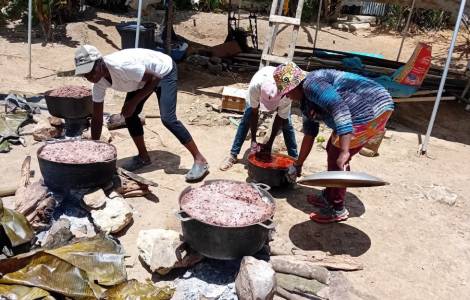
Pourcine Pic-Makaya (Fides News Agency) -“Without significant resources, we managed to have a meaningful day, honoring the Flag, a symbol of unity, and celebrating every Haitian's desire to return to a normal life.” This is what Camillian missionary Father Massimo Miraglio said, referring to the national holiday of the Caribbean country and of the diaspora communities around the world, a celebration that was also recently commemorated in this small mountain community where he carries out his pastoral work.
The Camillian missionary also offered a brief assessment of the past few weeks, during which he met with the entire community. “In recent days, I met with the teachers of the Literacy school, we reviewed the current situation, and we planned the end-of-year activities.” We have 13 teachers and approximately 170 participants, distributed across 12 classes in different locations in Pourcine Pic Makaya. It's a project that will continue next year, encouraged by the participants' enthusiasm. We will move forward, learning from the mistakes made this year and especially strengthening teacher training.”
Father Miraglio also addressed the role of women within the community, still insufficiently represented in positions of responsibility. “Despite the efforts we are making, women continue to be underrepresented in key positions in our community,” he noted. However, he specified that some progress has been made: “If we consider that we started from scratch, there is small progress today; for example, in the parish school, five out of nine teachers are women. In general, in the Haitian school system, teachers are mostly men, with the sole exception of early childhood education, where the teaching staff is composed exclusively of women.”
Another topic addressed by the Camillian missionary was the area's main source of income: the bean harvest. "The harvest has been good for a minority and acceptable for many; for some families it hasn't been good, and for a minority it has been terrible," he explained. "Unfortunately, on the parish land, the harvest has been terrible. Too much rain in shaded and very damp soil, coupled with late planting: we've lost the crop. This year, in short, we'll live on charity, on whatever beans people are willing to share with us." He added that in the coming weeks, those who own land above 1,500 meters or in damp ravine areas will begin preparing the soil again for planting in July.
The overall situation in the country remains extremely precarious. Some 6.4 million people, more than half the population, need humanitarian assistance. According to the Infection Prevention and Control (IPC) report of April 2026, 5.8 million people are at risk of acute food insecurity. Much of the population lives in fragile conditions, a reality exacerbated by mass displacement, limited access to essential services, and increased security risks, demanding a rapid, coordinated, and multisectoral humanitarian response. (AP) (Fides News Agency, 2/6/2026)