
Information service of the Pontifical Mission Societies since 1927
AICU Kerala
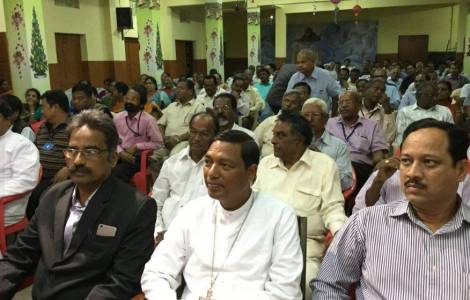
Mangalore (Agenzia Fides) - The so-called "anti-conversion laws" in force in twelve Indian states are "a wound to Indian democracy, national ethics, freedom of belief, conscience, and expression." For this reason, lawsuits have been filed before the Supreme Court in several states, challenging them as "unconstitutional." This is what the "All India Catholic Union" (AICU), the largest movement of Catholic lay people in India and throughout Asia, said during its current General Assembly in Mangalore, expressing its concern about the difficulties and hostility towards Christians in several Indian states, essentially based on the controversial anti-conversion laws.
As the AICU, founded 106 years ago and now led at the national level by Elias Vaz, notes, these measures aim to "reduce freedom, constrain consciences, and make religious beliefs subject to judicial approval. They are then exploited and manipulated by Hindu nationalist groups to criminalize non-Hindu communities, especially Christian and Muslim religious minorities, Dalits (outcasts), and indigenous peoples," the organization complains. The AICU General Assembly rejects hate campaigns and hostility toward religious minorities and is launching "Bandhutva," an interfaith dialogue session on compassion, in which representatives of various religious communities will evoke the spirit of Mother Teresa and Mahatma Gandhi. The assembly, which was attended by approximately 150 delegates from across the country, will also address the topic of "crisis management" in this context, i.e., the steps to be taken when confronted with a critical event such as an attack, violence, or controversy. The AICU recalls that measures restricting or preventing conversion are currently in force in the following Indian states: Rajasthan (since 2025); Karnataka and Haryana (since 2022); Madhya Pradesh, Uttar Pradesh, and Gujarat (since 2021); Himachal Pradesh (since 2019); Uttarakhand (since 2018); Jharkhand (since 2017); Chhattisgarh (since 2006); Arunachal Pradesh (since 1978); and Odisha (since 1967). John Dayal, journalist and member of the AICU, told Fides: "Since the Hindu nationalist Bharatiya Janata Party (BJP) came to power in 2014, many Indian states have introduced new laws criminalizing religious conversion or significantly tightened existing laws in this area. These laws are based on the false assumption that religious minorities pose a threat to the nation's identity and unity." As Dayal recalls, such laws are also linked to population growth, often used as a bogeyman by Hindu nationalist groups, according to which "the supposedly rapid growth of non-Hindu religious communities could replace Hindus as the country's cultural, social, religious, and political majority." While conversion laws have existed in some Indian states since the late 1960s, "they have multiplied and become more stringent in the last decade," Dayal notes, such as in the states of Gujarat, Haryana, Himachal Pradesh, Jharkhand, Karnataka, Madhya Pradesh, Uttar Pradesh, and Uttarakhand. "These are all states where Hindu nationalism is deeply rooted in both government and civil society," the journalist notes. According to the 2025 bill passed by the BJP government in Rajasthan, conversion is considered illegal and void if it occurs through "false representation, force, undue influence, coercion, inducement, or other fraudulent means, or through marriage." "The use of ambiguous terms allows almost any religious conversion to be interpreted as 'illegal,' in some way, effectively preventing free individual choice," Dayal notes. Furthermore, the laws are based on the assumption that religious conversion is inherently illegal until proven otherwise: They explicitly shift the burden of proof to the "person seeking to change faith" to demonstrate that no fraud or coercion has occurred. Furthermore, the punishment for the illegal conversion of Dalits, Adivasis (indigenous people), women, and children is much harsher, as these are the social groups that Hindu nationalists rely on to build the desired "Hindu majority" in India. In Hindu nationalist ideology, these people are considered "easily seduced." The AICU reiterated its commitment to protecting the rights and freedoms of faith and conscience of every person in India. (PA) (Agenzia Fides, 24/9/2025)

Matters India



 ASIA/BANGLADESH - Riots after the assassination of student leader Hadi; Bishop Subroto: “Worrying situation”
 ASIA/PAKISTAN - Christians give the nation the spirit of Christmas: fraternity and peace
 AMERICA/CUBA - Caritas continues distributing humanitarian aid: “We cannot reach everyone, but we want to remain close to those most in need”
 LEO XIV IN SPAIN - The Pope in the port of Arguineguín: “Every individual that arrives asks us what remains of our humanity”
 ASIA/MONGOLIA - COP17: The gift of faith in Jesus and care for creation in the witness of a young Mongolian woman
 Faith according to Joseph Ratzinger: “Like a child in his mother’s arms”
 Leo XIV: The Catholic Church has contributed to the development of the United States
 ASIA/INDIA - Christian officer's appeal rejected: "Freedom of conscience trampled upon"
 AMERICA/PERU - Pontifical Mission Societies and the National Office for Catholic Education join forces for missionary formation in the country's schools
 ASIA/CHINA - Duan Yijun appointed new Director of the Chinese Department of Religious Affairs
 ASIA/INDIA - Anti-conversion laws: Catholics promote protection of freedom of conscience based on the constitution
 ASIA/HONG KONG - Celebration of the 105th anniversary of the founding of the “Legion of Mary”
 ASIA/INDIA - Association of Lay Catholics: "In the new year, the commitment to free society from hatred and discrimination"