
Information service of the Pontifical Mission Societies since 1927
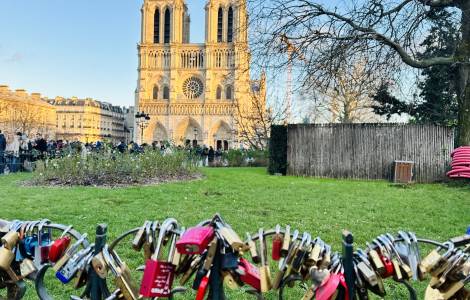
photo MLK
by Marie-Lucile Kubacki
On September 25 and 26, Pope Leo XIV will travel to Paris and Saint-Denis, the first French stops on a journey that will also take him to Lourdes and Metz. Over the course of these two days, his itinerary will bring to light various layers of the capital’s Christian history.
From traditions linked to Denis, its first bishop, to the new faces of the baptized communities, from places of learning to shelters, in Paris too the same question reaches the present day, spanning the centuries:
how can the Gospel be proclaimed in a changing world? Paris, too, has a topography of mission, imprinted as much in its stones as in the lives of its people.
In the legendary footsteps of Saint Denis
During his meeting with the people of Paris on Friday afternoon, the Pope will travel by popemobile along the 2.5-kilometre route separating Notre-Dame-des-Champs church from Place Saint-Michel. A true journey back to the origins of evangelization in Paris.
The account published by the parish links the name Notre-Dame-des-Champs to a shrine that no longer exists, situated in the in the neighborhood of today's rue Pierre-Nicole. Tradition holds that this was the site where Saint Denis preached to the inhabitants of Lutetia, and it preserves the memory of another name: Notre-Dame-des-Vignes. In the midst of today's urban chaos, it is difficult to imagine those still-open fields, those vineyards on the doorstep of people’s homes. Legend has it that an adventure began there which would leave a lasting mark on Paris.
Although the figure of Denis was greatly glorified in the “Legenda Aurea”, he does not belong solely to the realm of fantasy: at the end of the sixth century, Gregory of Tours presents him as one of the bishops sent to evangelize Gaul and recounts his martyrdom during the Roman persecutions. Written several centuries after the events, this testimony must nevertheless be distinguished from the archaeological evidence, which highlights the antiquity of the burial site and shrine of Saint-Denis without, however, recounting all the episodes of his life.
At the heart of this memory stands the figure of a missionary bishop: a ‘mission ad gentes’ at the dawn of Christianity in Paris.
The former priory of Notre-Dame-des-Champs, later converted into a Carmelite convent, was demolished during the Revolution. The present church, built from 1867 onwards on boulevard du Montparnasse, took up its name. The context had changed. The task was no longer to bring the Gospel to the inhabitants of ancient Lutetia, but to give it a home in nineteenth-century Paris, a city undergoing profound transformation.
Not far from there, on rue de Vaugirard, another chapter in the history of mission was being written: that of the Institut Catholique de Paris, founded in 1875 in the former Carmelite convent, thanks to the Laboulaye Law on freedom of higher education.
In its presentation of its historic coat of arms, the institute recalls that St. Denis appears there alongside the Virgin Mary and St. Catherine of Alexandria. The first bishop of Paris thus finds his place in a setting dedicated to study: another way, along this journey, of addressing the question of the transmission of the faith.
The following morning, Leo XIV will to meet members of the provincial synodal Assembly, catechumens and neophytes. The transmission of knowledge will thus intersect with the first steps in faith. On Friday, the public tour will conclude at Place Saint-Michel, at the foot of the fountain erected between 1858 and 1860 in Haussmann's Paris. Napoleon I might have occupied its central niche; instead, it was ultimately given to the Archangel Michael defeating the devil, an image of the struggle between Good and Evil. From memories of the first evangelization to debates over the role of Catholics in modern society, the neighborhood thus offers a historical excursus and, at the end of the journey, an angel.
Notre-Dame: Risen Again
It is at Notre-Dame that Leo XIV will celebrate Vespers with the bishops, priests, deacons, consecrated men and women, and seminarians of France.
If there is one place where national memory and that of the Church intertwine, it is this cathedral. Victor Hugo's novel has earned it admirers around the world, while its doors welcome both the faithful and visitors seeking beauty, silence or simply a little coolness. People enter to pray, light a votive candle, or raise their eyes. Sometimes simply to remain there.
Beneath its vaults unfolds a history whose origins long predate the Gothic building project begun in the twelfth century. The ancient church of Saint-Étienne and the baptistery of Saint-Jean-le-Rond belonged to a religious complex that preceded the present cathedral. The chronology and layout of these early buildings, however, remain the subject of debate amongst scholars. The stones have not yet revealed all their secrets.
The Gothic building itself preserves traces of this earlier history, notably in twelfth-century sculptures reused in the Portal of St. Anne. This was followed by extensions, chapels, the transept façades, decorations and reliquaries; the veneration of Saint Marcellus, the ancient Bishop of Paris, has also enriched the cathedral’s heritage.
Not far from there, Saint Louis IX commissioned the Sainte-Chapelle to house the relics of the Passion, including the Crown of Thorns. The Crown, together with a portion of the Wood of the Cross and one of the Nails of the Passion, is now preserved at Notre-Dame.
It is in this cathedral that Leo XIV will come to pray, following the devastation of the Revolution, subsequent restorations and the 2019 fire. A cathedral risen twice, whose strength derives not only from what it has endured, but from what continues to live within it.
During Vespers on September 12, 2008, Benedict XVI recalled Paul Claudel's conversion there and spoke of Notre-Dame as a “theatre of lesser-known conversions, but no less real,” and as a “pulpit where preachers of the Gospel, such as Fathers Lacordaire, Monsabré and Samson, were able to pass on the flame of their passion to one of the most diverse audiences.”
Beyond the monument, Notre-Dame is a place where lives change direction. And, for French Catholicism, tested by successive crises, it offers the image of a history whose final word has not yet been spoken.
Bakhita: mission in the city
On Saturday morning, Leo XIV will visit the Maison Bakhita, in the 18th arrondissement, a place dedicated to accompanying and integrating people in exile. Here, mission will take on another face: that of hospitality, encounter and everyday patience.
The Maison takes its name from Josephine Bakhita, the Sudanese woman who was enslaved, tortured and sold, and who later became a religious sister in Italy before being canonized by John Paul II on October 1, 2000. It seeks to respond to the appeal Pope Francis launched in 2017: to “welcome, protect, promote and integrate” people in exile. Four verbs that give concrete form to the Gospel's call to welcome the stranger.
In France, the novel Véronique Olmi dedicated to her in 2017 helped make Bakhita known well beyond Catholic circles. Ten years earlier, Benedict XVI had made her story one of the central figures of his encyclical ‘Spe Salvi’, devoted to Christian hope. In her encounter with God, he wrote, Bakhita had discovered “not only the small hope of finding masters who were less cruel, but the great hope: I am definitively loved and whatever happens to me—I am awaited by this Love” (Spe Salvi, §3). He continued: “Through the knowledge of this hope she was ‘redeemed’, no longer a slave, but a free child of God.”
Benedict XVI also emphasized the missionary dimension of this experience: “She felt obliged to spread the liberation that she had received through her encounter with the God of Jesus Christ” (Spe Salvi, §3). This hope, received in order to be shared, also sheds light on Pope Leo XIV's visit in Paris. In the face of the divisions generated by the reception of migrants, including within Christian communities themselves, the Maison Bakhita proposes beginning with encounter.
Saint-Denis: roots and wings
Over the weekend, more than 80,000 young people aged 17 to 35 are expected at the Stade de France for a prayer vigil with Leo XIV. In Saint-Denis, the journey will return to the name with which it began. The circle is symbolic rather than geographical: the circle of a missionary memory.
According to legend, Denis, beheaded in Montmartre, picked up his own head and walked northwards to the place of his burial, in present-day Saint-Denis. Around this tomb the basilica arose, later becoming the necropolis of the kings of France. Here too, the stones would have much to tell.
Charlemagne attended the consecration of the Carolingian church by Abbot Fulrad on February 24, 775. In the thirteenth century, St. Louis came there to receive the pilgrim's insignia before departing for the crusade. In September 1429, Joan of Arc laid down her armour there after the failed assault on Paris, then held by the Anglo-Burgundians. Gestures of trust, but also moments of trial: Christian memory is not made up solely of victories.
This history may seem remote to some of the young people gathered at the stadium. Not all will have received the same stories. Other family traditions, other languages and other spiritual journeys will shape the way they pray. But receiving an inheritance does not necessarily mean resembling it in every respect. It also means giving it new faces.
The Diocese of Saint-Denis offers a concrete example: it is selling caps and wax-print fabrics to help fund the papal visit. The choice lends the preparations for the journey a festive and colorful atmosphere. It may also be read as a sign of a popular Church, where faith is passed down without erasing the diversity of people's identities and backgrounds.
From the memory of ancient Lutetia to the stands of the Stade de France, from the restored stones of Notre-Dame to the welcome offered by the Maison Bakhita, these stops mark not so much a return to the origins as a way of extending them.
Mission can be understood as a twofold movement: receiving a history and responding to new encounters, under the impulse of the surprises of the Holy Spirit, as Pope Francis liked to recall.
Leo XIV's itinerary may be read in this light: the future of the Christians of France lies neither through nostalgic withdrawal nor in oblivion. It requires roots, deeply embedded in the long history of martyrs, kings and the poor. It also requires wings, to reach out to new lives and new worlds. Between this fidelity and this boldness, the mission continues on its path.
(Fides News Agency, 18/9/2026)



 VATICAN - Cardinal Luis Antonio Tagle is the new Dean of the Sacred College of Cardinals
 CHINA/VATICAN - From “exceptional event” to a common practice: Chinese bishops take part in Holy See initiatives
 In Malawi, a whole stadium celebrates 100 years of World Mission Sunday: “United in Christ, united in mission”
 Missions in upheaval: World Mission Sunday during the years of war
 VATICAN - Sister Mary Teresa Barron appointed adjunct secretary of the Dicastery for Evangelization and president of the Pontifical Mission Societies
 One hundred years later. The long journey of China’s first Bishops to receive Episcopal Ordination from the Successor of Peter
 Pope in France/III - Metz, at the roots of European peace in the “city of three borders”
 AMERICA/PERU - Edgard Rimaycuna, secretary to Pope Leo XIV, brings the Pope's blessing to Chiclayo