
Information service of the Pontifical Mission Societies since 1927
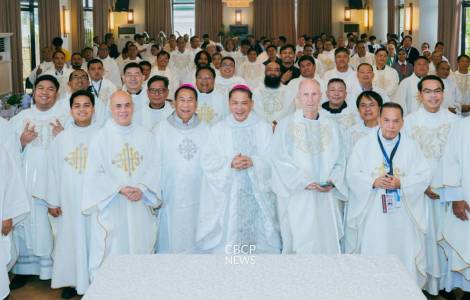
foto credit:CBCP News
Tacloban City (Fides News Agency) – Mission is also expressed in the Church’s capacity to accompany people in the concrete questions that shape their lives, including their participation in public affairs. This was the perspective proposed by Archbishop Gilbert Garcera of Lipa, president of the Catholic Bishops’ Conference of the Philippines (CBCP), during the 70th national assembly of the Pontifical Mission Societies-Philippines, held in Tacloban City.
With the next presidential election in the Philippines expected in 2028, the Archbishop called on Church communities to help the faithful form their consciences and take part responsibly in the democratic process. He did not present this task as a political intervention by the Church, but as one dimension of evangelization: a missionary community, he said, remains close to people and helps them read the realities of life in the light of faith, truth and human dignity. “A truly missionary Church does not impose political choices, but it helps the faithful discern wisely, participate responsibly, and promote the common good with a heart shaped by the Gospel,” Archbishop Garcera said.
In this approach, voter formation is linked to a missionary Church that is not enclosed within its own structures, routines or internal concerns. The Archbishop urged parishes to develop an outward-looking pastoral style, attentive above all to the poor, young people, marginalised persons and those who have gradually moved away from ecclesial life. For him, evangelization requires presence, listening and accompaniment wherever people experience their daily social, professional and family responsibilities. “Mission begins wherever we live, work, study, and serve,” he said, underlining that the Church’s missionary task belongs to every baptized person, not only to specialised agencies or missionaries sent abroad.
The address was delivered before the national assembly of the Pontifical Mission Societies-Philippines, an occasion that also allowed the CBCP president to encourage reflection on concrete ways in which the generosity and vitality of Filipino Catholic communities could support evangelization beyond national borders. Pointing to the contribution made by Catholics in South Korea and Japan, despite their comparatively smaller communities, he invited the faithful in the Philippines to deepen their commitment to missionary cooperation, as related on the CBCP website.
For Archbishop Garcera, this missionary renewal is also inseparable from the implementation of the Synod on Synodality. He described synodality as a lived ecclesial practice rather than a further institutional programme: a way of listening, discerning and walking together. The task facing Philippine dioceses, he said, is now to give practical expression to the Synod’s orientations. “The work of the Synod did not end with the publication of its Final Document,” he said. “The question before us is no longer simply, ‘What is synodality?’ but rather, ‘How shall we live it?’”
(MLK) (Fides News Agency, 21/8/2026)



 THE CHURCH OF THE SHEAVES CONFERENCE - Listening the Continents: Gifts, Challenges and New Missionary Pathways
 “Gifts to give and gifts to receive”: The Church of the Sheaves opens its first international conference in Rome
 COLOMBIA - "Mission remains urgent": the Colombian Church renews its missionary commitment on the centenary of DOMUND
 100th WORLD MISSION SUNDAY - Pope Leo XIV: May the Church always remain faithful to the mandate of the Risen Lord