
Information service of the Pontifical Mission Societies since 1927
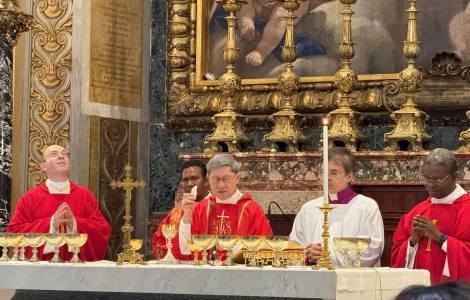
foto Pascale Rizk
Vatican City (Fides News Agency) - “Mission is not a strategy or a mere strategic plan, but a true participation in God’s mission.”
With these words, Cardinal Luis Antonio Tagle recalled the profoundly spiritual dimension of missionary dynamism that moves the Church during his homily in St. Peter’s Basilica. The Eucharistic celebration took place on June 1 in the Choir Chapel, on the occasion of the meeting of the General Assembly of the Pontifical Mission Societies.
Commenting on the Gospel passage read in the day's liturgy, taken from Mark (Mk 12:1-12), in which Jesus recounts the parable of the murderous vineyard workers ("They took the beloved son, killed him, and threw him out of the vineyard"), the Cardinal Pro-Prefect of the Dicastery for Evangelization - Section for First Evangelization and New Particular Churches, offered a reflection focused on the responsibility of believers as stewards, not owners, of God's gifts. "In the Gospel," he explained, "Jesus addresses the chief priests, the scribes, and the elders. His primary audience was, therefore, the Jews, the religious, cultural, and social leaders of that time. Through the parable, he shows that God cares for his people. The vineyard is an image of the people of Israel and expresses God's constant care for them." However, the Cardinal added, the people's behavior reflects an unstable relationship with God: "Sometimes they remember God's truths, other times they forget them. Sometimes they praise him, other times they choose other gods." This is the people called to be the people of God. But God remains faithful.”
Despite the variability of the people’s faithfulness to God, there is a dynamic of remembering and forgetting that offers a concrete pastoral key. The Cardinal observed: “We have a long list of problems to solve, but we don’t have a list, a memory, of God’s blessings for us.” This contrast between the “list of problems” and the “memory of blessings” suggests that crises of faith arise not only from real difficulties—which should neither be minimized nor denied—but from the loss of the memory of God’s action. “Yes, we have always had difficulties and we will always have them, but let us open our eyes to the marvelous action of God in our lives, even against our will,” the Cardinal insisted.
In the parable of the vineyard workers, the Cardinal continued, a message is also conveyed that invites a serious examination of conscience. “Why do the vineyard workers begin to forget that they were stewards?” They don't want to share the harvest; they want to keep it for themselves. And that leads them to reject those whom the owner has sent to claim their share. And when even the owner's son is sent, they say, “If we kill the son, there will be no heir. We will become heirs,” he recalled, drawing a parallel to the present day. “This is the situation to this day,” the Cardinal affirmed. “Let us look at all the conflicts, the wars that have taken place in the world and, sadly, also within the Church.” He then warned: “If we forget our identity as stewards to whom the Lord has entrusted the care of his vineyard, we may have done God a disservice and even ruined the vineyard.”
This, the Cardinal insisted, is a fundamental aspect of mission, which “is truly a participation in the mission of God, the Father who cares for his people.” The Cardinal then encouraged all those present at the Mass—among them the more than one hundred national directors of the Pontifical Mission Societies who had come to Rome from all five continents—to praise God for one another: “Perhaps you haven’t realized it, but each one of us is a precious gift from God. We may have limitations, each one of us, but we are precious gifts from God. And we want to give thanks and praise to God for one another. To all who are united, formally or informally: I ask you not to forget that we are part, however unworthy, of God’s blessing for the Church. Let us take care of one another. Let us take care of the mission.”
A true missionary mission took place moments before the audience of the participants in the General Assembly of the Pontifical Mission Societies with Pope Leo XIV, and a reminder that the source of missionary zeal lies not in strategies or action plans, susceptible to being questioned at the slightest difficulty, nor in the personal genius of any individual, but in the recognition of an invaluable and freely given gift: that of God, which must be cherished. An echo of the First Letter of Saint Paul to the Corinthians: “If I give away all I have, and if I deliver up my body to be burned, but have not love, I gain nothing.” (ML) (Fides News Agency, 1/6/2026)

 Cardinal Tagle to the Churches of Asia: “Walking Together”: Learning from the First Steps of a Child


 Father Camerlengo: The gift of Osório, killed by evildoers, becomes a seed
 Four centuries at the service of the Gospel: the Palace of Propaganda Fide and the Urban College
 Seminaries in Africa, Father Guy Bognon (POSPA): Bishops must be directly involved in the formation of seminarians
 Papua New Guinea’s hidden treasure: The wisdom of elder missionaries
 Cardinal Tagle urges Asian Churches to recognize everyday life as the horizon of Christian experience: "Marvel at what Christ is accomplishing in silence"
 Leo XIV to the FABC Assembly: Continue to promote a “Eucharistic spirituality” within the Churches of Asia
 Tomáš Halík at the FABC Assembly: «The future of Christianity will depend upon whether our communities become places where people truly learn to see»