
Information service of the Pontifical Mission Societies since 1927
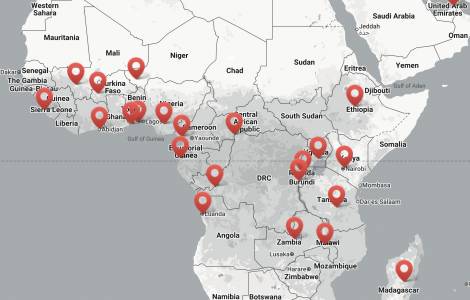
i punti di presenza del movimento dei Focolari in Paesi dell'Africa sub-sahariana
by Victor Gaetan*
Nairobi (Agenzia Fides) - The classic image of a Catholic missionary is a devout religious person who leaves home for a remote location, then never, or infrequently, goes home, becoming thoroughly dedicated to building the Church in one foreign place. Missionaries like this still function. Similarly, the stereotype of a religious sister assisting a prelate is often linked to household management.
On a recent reporting trip to several African countries, I met wonderful examples of new forms of mission among consecrated members of the Focolare Movement and a consecrated Focolarina who topples the image of a non-descript, nameless nun.
She is Filipina Nilda Castro, a Focolarina whose career between Rome and Manila demonstrates the missionary range of the movement founded by Chiara Lubich.
Vatican Diplomacy
Castro completed two years of formation in Italy then went back to the Philippines to “build the movement” for six years.
She returned to Rome as an English language translator for a Church organization. Then, Chiara Lubich asked her to help Archbishop Giovanni Cheli, the Holy See’s permanent observer at the United Nations (UN) in New York who was returning to Rome in 1986 to take charge of the Pontifical Council for the Pastoral Care of Migrants and Itinerant People, absorbed into the Dicastery for Promoting Integral Human Development in 2017. Cheli wanted a fluent English speaker.
Keep in mind, Cheli was a pillar of Pope John Paul II’s diplomacy together with Cardinals Agostino Casaroli, Renato Martino, Luigi Poggi, Achille Silvestrini in the behind-the-scenes work to gain space and protect Catholics in the Communist countries during the Cold War.
Examples of Cheli’s unique role include visiting in late 1968 Romanian Greek Catholic bishop Iuliu Hossu, jailed by communists after they banned the Church he led, to offer him a chance to leave the country, with government approval, to be named a cardinal. Because Hossu would not abandon his decades-long struggle to legalize his outlawed church, Pope Paul VI made him a cardinal in pectore. Cheli was more successful in Hungary in 1971 when on behalf of the Holy See (working with the US Government to bring about the Helsinki Accords), he brought Cardinal Archbishop József Mindszenty to Rome, thus closing the “Mindszenty matter.” Later, he emerged as the most forceful Vatican critic against the US invasion of Iraq.
Nilda Castro proved especially useful to the diplomat because she has expertise in mathematics and computer programming: One of Cheli’s goals was to bring technology he used in New York to the Vatican. After updating her skills, she helped her boss upgrade their systems. She worked with Cheli until his retirement in 1998, just months after he became a cardinal.
“Cardinal Cheli’a apartment was very close to our office and he often invited us to lunch—a very kind and friendly person!” she recalled.
A series of three cardinal bosses followed: Cardinals Stephen Hamao (who taught Latin to the Japanese prince, and future emperor, Akihito), Renato Martino, and Antonio Veglio, under whom she took a leading role in the civil aviation section. It was not unusual for Castro to represent the Vatican at inter-governmental meetings convened by the UN.
Return Home
In 2013, “I was asked to come back to the Philippines because the Focolare Movement needed help” as part of the center coordinating a zone that included Manila. Castro concentrated on questions around spiritual formation of different Focolare branches.
Despite retirement, two successive nuncios in Manila refused to let Castro go: She helped Archbishops Giuseppe Pinto and Gabriele Caccia (currently the permanent observer at the UN) manage the Holy See’s nunciature (embassy) including meetings and communication.
What did she help achieve? “Things that cannot be said,” shrugged the Focolarina, who confesses her extensive understanding of Roman process and procedure was appreciated by the nuncios.
Since Caccia moved to New York in 2019, Castro has dedicated herself 100% to the Focolare Movement, living at Mariapolis Peace, a “small town dedicated to love” where over 100 people reside—5 communities of women; 3 of men; young adults; priests and seminarians; and families.
“Chiara [Lubich] had in her heart to establish something to give witness to what a society would be like if everyone simply lived the Gospel. Her vision was a city where the only law is love,” explained Castro.
She continued, “Jesus is present in our midst. So, anybody who comes to Mariapolis Peace should feel His presence and know the people there love each other.”
Inter-religious Dialogue
Chiara Lubich became friendly with Nikkyo Niwano, founder of the Japanese Buddhist movement, Rissho Kosei-Kai. Both received the Templeton Prize for insights into religion. When he invited her to Tokyo, she took the opportunity to visit Hong Kong, Taiwan, Korea, and Philippines, where, according to Castro, she shared the impression that Christians must do more to know Asian religions.
So Chiara Lubich founded a school dedicated to Buddhism and Shintoism. Today, that school is a formation center teaching and training members on inter-religious dialogue.
The little towns of love, Focolare Mariapolis centers, continue in three places: outside Manila (Mariapolis Peace), on the outskirts of Nairobi (Mariapolis Piero), and in Ivory Coast (Mariapolis Victoria).
Transnational
Nilda Castro’s itinerary is quite unique, but it’s not unusual to hear other fascinating stories of mission that, for example, took a Focolarina with a nursing degree, Triphonie Barumwete, from Burundi to Cameroon to Democratic Republic of Congo to Italy to Kenya over the course of 30 years.
Or, to meet a Focolarino born in Cameroon, Marcellus Nkafu Nkeze, whose formation began in Italy then took him to Switzerland where he was a spiritual instructor; to South Sudan and Kenya where he managed humanitarian assistance; to Burundi where he served AIDs patients; then back to Cameroon where he coordinates Focolare activities in central Africa—while running a popular religious bookstore in Douala.
Moving between assignments, consecrated Focolare members maintain their commitment to realizing Jesus’s words, “That all may live as one.” (John 17:21). Unity and dialogue are at the heart of the Focolare raison d’etre, ever since Chiara Lubich founded the lay movement during World War II in Trent, Italy. (It took the Holy See several years in the 1950s to decide the movement was not heretical, as shown in the film “Love Conquers All.” It took another ten years to gain full approval, eventually from Pope Paul VI.)
Not only do members cross borders to plant, cultivate, and cross-pollinate communities, they move between different worlds—between jobs involving tremendously different skills.
*Victor Gaetan is a senior correspondent for the National Catholic Register, focusing on international issues. He also writes for Foreign Affairs magazine and contributed to Catholic News Service. He is the author of the book God’s Diplomats: Pope Francis, Vatican Diplomacy, and America’s Armageddon (Rowman & Littlefield, 2021) published in paperback in July 2023. Visit his website at VictorGaetan.org



 XII FABC Plenary Assembly: Asia's Bishops Renew Commitment to Synodal Mission and Bridge-Building
 Leo XIV to the FABC Assembly: Continue to promote a “Eucharistic spirituality” within the Churches of Asia
 ASIA/KAZAKHSTAN - The Church is speaking more and more Kazakh. Frather Jocher: "The Future of the Church lies with Kazakhs seeking Christ"
 EUROPE/AUSTRIA - Father Karl Wallner: "Faith grows together with the willingness to help others"
 "Like clay in the hand of the potter". Work on the "Positio" in the Cause for Canonization of Father Emiliano Tardif begins
 AMERICA/VENEZUELA - Gratitude for a missionary experience that changed one's vision on life
 The Pontificate of Leo XIV and Global Politics: A lecture by Massimo Faggioli at the Gregorian University
 ASIA/MALAYSIA - Malaysian Ambassador Assan: "Respect for international law, and the protection of human dignity is the path to peace in the Middle East and Southeast Asia"
 ASIA/CHINA - Chinese Catholic communities express their gratitude to women on their feast day
 A hidden tragedy: worldwide childbirth deaths are concentrated in war zones