
Information service of the Pontifical Mission Societies since 1927
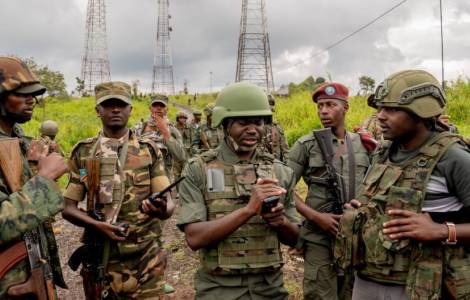
Kinshasa (Agenzia Fides) – "Following the advance of the M23/AFC, around one and a half million displaced people camped around Goma, relying solely on the help of people of goodwill. This is what hundreds of inhabitants from the village of Karenga and nearby villages, on the edge of Virunga National Park, did at the end of 2023," a local source from North Kivu told Fides. This eastern province of the Democratic Republic of the Congo was conquered at the beginning of the year by the M23/Congo River Alliance (AFC) guerrillas, backed by the Rwandan army.
Our source—who requested anonymity for security reasons—describes the ordeal of the displaced, forced to constantly change their destination. The most dramatic situation affects the Hutu of Rwandan origin, who are indiscriminately accused by both the M23/AFC and the Kigali government of being members of the Democratic Forces for the Liberation of Rwanda (FDLR), a guerrilla group composed of former soldiers from the old Rwandan army, mostly Hutu, responsible for the 1994 genocide and settled in eastern DRC for the past 30 years.
"In late January 2025, the M23 entered Goma and, the following month, forced people to abruptly leave the camps and return to their homes. Thus, the residents of Karenga returned to their village. At the end of February, the M23 and a local chief forced them to leave again, and about a thousand people moved to Sake, settling in schools and makeshift shelters.
On May 12, in Sake, the M23 gathered men, women, and children. The men were taken to the Unity Stadium in Goma, and those suspected of being FDLR were transported to an unknown location. Up to 2,000 people, registered by the United Nations High Commissioner for Refugees (UNHCR), were transferred to the Goma Transit Center, and many were taken to Rwanda. Between May 17 and 19, several convoys left the center to reach Rwanda. Rwandan authorities and UNHCR stated they were Rwandan refugees who would be reintegrated into Rwandan society.
This is a snapshot of the tragedy the Hutu population in North Kivu has been experiencing since May—many of whom are only distantly of Rwandan origin, yet are also Congolese citizens. Furthermore, one must not forget the more than 140 civilians, mostly Hutu, who were summarily executed by the M23 in at least fourteen villages and small farming communities near Virunga Park in July 2025.
The phenomenon of mass displacement has intensified: lines of women, children, young people, and, to a lesser extent, men are being taken to Rwanda, under the supervision of UNHCR. On August 25, over 500 were repatriated; on September 9, another 284 people crossed the border, accompanied by UNHCR. What happens to them afterward? There is no data. UNHCR assures that these individuals are crossing the border voluntarily, as required by international statutes and its own repatriation conditions.
The Hutu population has a tragic memory of what happened to refugees who returned to Rwanda since 1996. They know that this country not only lacks space and resources to offer a viable future to thousands of refugees (about 4,500 since the beginning of this year alone) but also lives under a climate of severe repression, where one group is constantly blamed. Returning from the DRC means being directly identified as FDLR member or an FDLR family member. It’s hard to believe this is a truly voluntary return!
In authoritarian contexts, compliance often does not mean voluntariness, but submission out of fear! The history of the past thirty years in the Great Lakes Region has shown that sometimes international humanitarian organizations have bowed to the will of local powers and the backroom directives of global powers that fund them.” (L.M.) (Agenzia Fides, 19/9/2025)



 AFRICA/MOZAMBIQUE - 900,000 people in Cabo Delgado need humanitarian assistance
 The hidden tragedy of suicides in refugee camps
 AFRICA/DR CONGO - Despite ongoing peace talks, massacres of civilians continue
 ASIA/INDIA - Archbishop Neli: "We need to consider whether closing the border between Manipur and Myanmar will have peaceful effects"