
Information service of the Pontifical Mission Societies since 1927
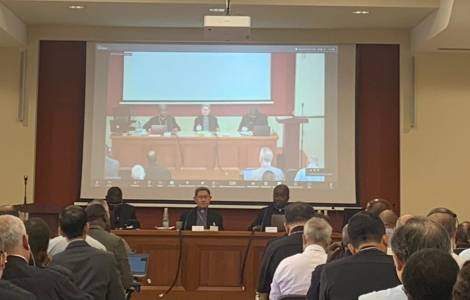
Rome (Agenzia Fides) - "It is God who has full trust in you, expressed through the Church, especially through the Holy Father, who names, appoints the bishops. But it is the Holy Spirit that appoints us. Let us never forget this," said Cardinal Luis Antonio Tagle, referring to the source from which "the beautiful vocation of bishop" must constantly draw throughout its journey. He addressed these words to the nearly eighty Successors of the Apostles who received episcopal ordination in the last year and who have come to Rome to participate in the formation course for newly ordained bishops organized by the Dicastery for Evangelization.
The first day of the formation course entitled "Paving the Way for Hope. Called to the Episcopal Ministry in the context of the Holy Year" took place on Thursday, September 4, in the meeting hall of the Pontifical College of St. Peter on Rome's Janiculum Hill. The course featured presentations by the heads of the Dicastery for Evangelization: Cardinal Tagle and Archbishop Fortunatus Nwachukwu – Pro-Prefect and Secretary of the Section for First Evangelization and New Particular Churches, respectively – and, in the afternoon, Archbishop Rino Fisichella, Pro-Prefect of the Section for Fundamental Questions of Evangelization in the World.
Custodians, not masters
To make the new Successors of the Apostles aware of the nature of their calling, Cardinal Tagle drew on the exhortations addressed to the "elders" by the Apostles Peter and Paul: "tend the flock of God in your midst, overseeing, not by constraint but willingly, as God would have it, not for shameful profit but eagerly" (1 Peter 5:2-3) and "keep watch over yourselves and over the whole flock of which the holy Spirit has appointed you overseers, in which you tend the church of God that he acquired with his own blood" (Acts 20:28).
Apostolic succession is not just a "succession of honor." It is not "our merit," it does not depend on "our qualifications." And for "us, limited and weak human beings as we are," there is always "the temptation to forget that it is the Holy Spirit who has called us there."
The Pro-Prefect of the Dicastery, who will celebrate his 25th anniversary as a bishop in 2026, highlighted, based on the words of the Apostles Peter and Paul, some characteristics of the vocation and mission of bishops, who act according to the Holy Spirit and the "living Tradition" of the Church.
If the episcopate is "a gift we do not deserve," the Cardinal stated, "we should receive that gift every day with humility and gratitude."
The second point emphasized in the recommendations of the Holy Apostles Peter and Paul is that "the episcopal ministry is a ministry of administration." The Church is "God’s flock." It is "the People of God" acquired by "the Precious Blood of Christ." And the bishops are merely "stewards, custodians" called to take care of the flock "according to the will and desire of the true owner, who is God." However, as "limited and human and weak people as we are, there is always the temptation to acquire ownership" and "to treat the church, even persons, the priests, the religious, as my objects that I own."
The bishops are called to "care for" the gifts that the Holy Spirit continues pouring into the community, but we might be wasting them. We might be neglecting them. "It is sad," Cardinal Tagle noted, "when a bishop who is graced but blessed to be a steward of God's people behave as owners, accountable only to themselves."
"How do we exercise our stewardship of the church? " asked the Cardinal Pro Prefect. "Beginning with our relationship with the clergy, with the religious, the religious women." "It pains us," he added, "to hear comments coming from some religious women that they are being treated in dioceses almost like slaves and not as daughters of the church. And sometimes their religious vow of poverty is being used or evoked in order to withdraw from them a decent contribution to live for their food, for their justice."
"Keep watch" over oneself
In the passages quoted by Cardinal Tagle, both Saints Peter and Paul recall the task entrusted to bishops to "keep watch" and "be vigilant". A watchfulness over the life of faith that is also exercised "in the areas of doctrine, worship, and prayer" and that must also be applied to oneself, for, as Saint Paul says in the Acts of the Apostles: "savage wolves will come among you, and they will not spare the flock." Saint Paul, the Cardinal emphasized, indicated that the wolves could also be within the ecclesial community by calling the elders of Ephesus, to whom he addressed the need to watch over ourselves as well. "Pastors must pray" in order to "guide our people well," Cardinal Tagle repeated, before emphasizing communion as another characteristic of a fruitful episcopal ministry. For the Holy Spirit "gives different gifts, diverse talents, diverse cultures, but it is the same Spirit that unites all." And the bishop is called "to be a person able to bring the diversity into a unity animated by the Spirit."
The Missionary Dicastery's Service to the Local Churches
In his address, Archbishop Fortunatus Nwachukwu spoke about the diverse work of the Dicastery for Evangelization in the service of the first evangelization and the new particular Churches, recalling that the reform enacted by Pope Francis through the Apostolic Constitution "Predicate Evangelium" also aims to redesign the work of the Vatican Dicasteries "in the spirit of a 'missionary conversion'."
The Archbishop affirmed that all particular Churches, even the youngest, are called "to assume their responsibilities at the pastoral and leadership levels. Therefore, the Dicastery's task is to accompany, support, and collaborate with them, while respecting their necessary autonomy."
Specifically, the Nigerian Archbishop gave an overview of the structures and working methods by which the Second Section of the Dicastery for Evangelization carries out its service to the particular Churches and provided information on the organization of the Dicastery.
The Archbishop referred extensively to the official statistics of the Holy See, which show that, even in recent years, the numerical increase of Catholics appears most marked in Africa, while a significant decline has been observed in Europe. At the same time, he added, "most men and women of our time do not know Christ," which is why the initial proclamation is always "an urgency and a necessity."
Among the data presented in his report, Archbishop Fortunatus pointed to the 1,126 ecclesiastical circumscriptions, primarily in Africa and Asia, for which the Missionary Dicastery is responsible for all their affairs—including the appointment of bishops. In 2025, according to Archbishop Nwachukwu, 52 bishops were appointed in the territories under the jurisdiction of the Missionary Dicastery from January to the beginning of July.
The detailed report also addressed the Missionary Dicastery's contribution to the formation of priests—through support of seminaries and local formation centers—and to the formation of catechists. The Dicastery also supports the formation of seminarians, religious sisters, and priests from the territories under its jurisdiction at the Pontifical Universities in Rome. Each year, more than 200 new students are admitted to the various colleges belonging to the Dicastery, which also includes the Pontifical Urbaniana University.
Archbishop Nwachukwu also referred to the Missionary Dicastery's Historical Archives, which consist of approximately 11 million documents in 14,000 volumes.
Evangelization and the enigma of Artificial Intelligence
In the afternoon, the Course participants listened to the lecture "Proclaiming the Word of God in Our Times" by Archbishop Rino Fisichella, Pro-Prefect of the Dicastery for Evangelization, Section for Fundamental Questions of Evangelization in the World.
The lecture referred to the Word of God as the source of apostolic activity, with the Pro-Prefect considering how "significant it would be if bishops were to resume catechesis for the People of God in their cathedrals," re-embracing the ministry of the Bishop as "first catechist."
The urgency of evangelizing and proclaiming Christ, Archbishop Fisichella continued, citing Paul VI's Apostolic Exhortations "Evangelii Nutiandi" and Pope Francis' "Evangelii Gaudium," today calls to "respond to the widespread demand for spirituality, which was impressively demonstrated by the multitude of young people who, together with Pope Leo XIV, were present in silent prayer during Eucharistic Adoration at Tor Vergata, just outside Rome, during the vigil of the last World Youth Day."
The Apostolic work is also called today, according to the Pro-Prefect, to "affirm the primacy of grace, because 'gratia facit fidem,' grace is what creates faith," Archbishop Fisichella said, quoting a phrase from St. Thomas Aquinas.
The work of evangelization, the Archbishop continued, must also address the scenario of the new digital culture and the recent development of artificial intelligence: "It is always available, friendly, responds immediately, provides millions of pieces of data, and when asked who God is, it answers. Availability at any time and in any situation, and that alone creates culture and expectation." A machine that has the upper hand shapes behavior, the Pro-Prefect emphasized.
Even "our 25-year-old priests breathe the same air." And "all this is not without pain," since, in Archbishop Fisichella's view, the idea of "regulating" the invasive wave of artificial intelligence through laws and regulations seems unrealistic, since it knows no borders or territorial barriers, is not interested in boundaries, and goes everywhere. It is, so to speak, "universal." A new "universalism" that, precisely through its willingness to always provide "useful answers" to every request and every need, undermines "the relationship with truth and freedom." For "with its generous availability, it can provide infinite amounts of data, but it is not interested in the truth." (GV) (Agenzia Fides, 5/9/2025)

 Cardinal Tagle to the Churches of Asia: “Walking Together”: Learning from the First Steps of a Child


 ASIA/CHINA - Father Joseph Chang Yanfeng ordained Bishop of Chifeng
 "You will see greater things": FABC opens its 12th Plenary Assembly in Jakarta
 Father Camerlengo: The gift of Osório, killed by evildoers, becomes a seed
 Four centuries at the service of the Gospel: the Palace of Propaganda Fide and the Urban College
 Cardinal Tagle urges Asian Churches to recognize everyday life as the horizon of Christian experience: "Marvel at what Christ is accomplishing in silence"
 Leo XIV to the FABC Assembly: Continue to promote a “Eucharistic spirituality” within the Churches of Asia
 Tomáš Halík at the FABC Assembly: «The future of Christianity will depend upon whether our communities become places where people truly learn to see»