
Information service of the Pontifical Mission Societies since 1927
By Victor Gaetan
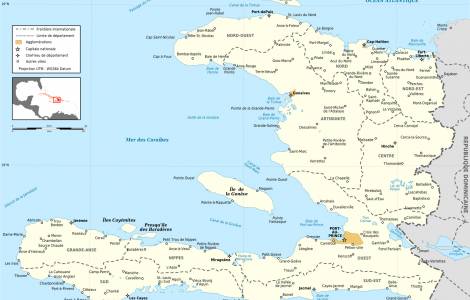
Port-au-Prince (Agenzia Fides) - “Hell in Haiti” declares a headline in the British Daily Mail last week. It recounts how dead bodies litter streets, typically murdered by gangs controlling over 90 percent of Port-au-Prince, the country’s capital.
Over 5,000 civilians have been brutally killed in 2025 according to the United Nations. And at least 184 were murdered last week.
On the morning of August 3, Gena Heraty, an irish lay missionary and a three-year-old child with a disability and other seven people were kidnapped by an armed group that attacked an orphanage on the outskirts of the capital.
Innocent citizens are targeted to eliminate dissent and instill fear: Bodies are sometimes burned alive, decapitated, mutilated, or dragged through streets.
Few schools are open in Port-au-Prince. Instead, kids are recruited as domestic combatants. UNICEF reports a sharp increase in sexual violence against these children.
As a result of urban war zones, pitting police against armed insurgents, some 1.3 million people (of an 11 million population) are homeless, many living precariously in makeshift camps—where food shortages are exacerbated.
Areas of the country outside the capital are more peaceful, but gang control of major airports and most ports means humanitarian assistance, medicine, and food are in dangerously limited supply—and conflict is spreading.
Archbishop Thomas Wenski of Miami, Florida where some 400,000 Haitians live, reassures us, “The Church is still with the people despite all the problems.” Outside the capital, he understands that “the Church is still very involved in various activities such as education, health care, and assisting the people.” (Over 1.5 million Haitians live in the US).
Security Collapse
Monsignor Juan Antonio Cruz Serrano serves as the Holy See’s permanent observer to the Organization for American States (OAS), In an interview at the Holy See’s nunciature in Washington, DC, the diplomat said security must be the top priority because without it, human rights, development, and democracy are impossible.
“Our second priority is humanitarian aid because more than two million Haitian people are living at the level of famine,” he confirmed.
Tragically, security has been absent in Haiti for many years. No president has been elected since 2016 when Jovenel Moise took office. But Moise was murdered in his bed, in the presidential palace, by foreign mercenaries (collaborating with the president’s own security, it seems) in 2021. Since then, state authority has disintegrated.
How did we get here?
Haiti was once France’s richest colony based on coffee and sugar production. Badly abused and mistreated, former slaves successfully overthrew the French in 1804 and declared independence, but the French government extracted massive debt from the new country by threatening invasion, crippling Haiti’s development. When a local president was assassinated in 1915, the US occupied Haiti under the guise of restoring stability—and remained until 1934. It, too, pillaged the nation financially.
Reflecting on this history can inspire tears…especially when we consider the case of a missionary priest who served as Haiti’s president three times: February-October 1991; 1994-1996; and 2001-2004.
Duvalier, Aristide and the present chaos
Born in 1953, Jean-Baptiste Aristide came of age during the father-son regimes of Papa Doc Duvalier (1957-1971) and Baby Doc Duvalier (1971-1986). His education with the Salesian order began at age 5 and he was ordained in 1982 after study in the Dominican Republic, Italy, Greece, and Palestine. As curate of a poor parish in Port-au-Prince, he preached social justice.
When Baby Doc fled the country, the Salesians asked Aristide to refrain from political statements. In September 1988, Aristide’s church was attacked with machine guns and machetes during Sunday Mass, killing 12 people and injuring 77 others. Then they set the church on fire with gasoline.
Yet, Aristide escaped and his popularity skyrocketed. His order decided to transfer him to Canada. The priest refused to leave so the order expelled him in December 1988.
In 1990, Aristide won the presidency with 67% of the vote in an election often termed Haiti’s first authentically democratic election. He did not seek a dispensation from the Holy See when he ran. His effort to put the army under civilian control contributed to a bloody military coup just 8 months later.
Foreign diplomats protected him from assassination, and he took residence in Washington, DC, from where he successfully lobbied the US Congress and the Clinton administration to restore him as president of Haiti.
Three years later, the US military executed “Operation Restore Democracy” to return Aristide to power—at the tip of a spear. It was a “look-strong operation” as one historian quipped. Soon after the popular leader returned to the presidential palace, he formally resigned as a priest, stating that presidential duties required his full attention. (Two years later he got married).
Peaceful transfer
When Aristide’s 5-year term ended in 1996, he resigned as agreed, facilitating the first peaceful transfer of power to a new president.
Aristide was re-elected in 2001, again by a big margin. only to be removed three years later by the same people who brought him back to Haiti: US General Colin Powell, for example, negotiated Aristide's return in 1994 as a senior military figure, then as Secretary of State, was the architect of his removal twenty years later.
Why? One reason, according to a 2022 New York Times investigative series, was the fact that France, with US support, was horrified at a campaign President Aristide launched for restitution payments of over $21 Billion from the French government (based on extensive research he did on the country's finances since independence). Beginning in 1825, Haitian governments, threatened by French invasion, paid excessive and unaffordable debt that impoverished the nation when it should have been investing in its people and domestic economy.
Whatever the motive, in 2004, Aristide was hustled out of Haiti on a plane with the US military and deposited in the Central African Republic. He called it a “modern kidnapping” in an on-air interview soon after.
A year after the 2010 earthquake that killed 200,000 people and injured 300,000, Aristide returned to Haiti. But the government began harassing the former president with legal threats. Yet, efforts to find him guilty of corruption or trafficking in drugs or arms found nothing.
To mark Jean-Baptist Aristide’s birthday last month, when he turned 72 [DOB: 7/15/53], supporters rallied at his house in the Tabarre neighborhood of Port-au-Price but no one was there. (Agenzia Fides, 6/8/2025)
*Victor Gaetan is a senior correspondent for the National Catholic Register, focusing on international issues. He also writes for Foreign Affairs magazine and contributed to Catholic News Service. He is the author of the book God’s Diplomats: Pope Francis, Vatican Diplomacy, and America’s Armageddon (Rowman & Littlefield, 2021) second edition in paperback in July 2023. Visit his website at VictorGaetan.org



 ASIA/LEBANON - Leo XIV to the Lebanese: Rebirth begins with small lights and small shoots
 ASIA/LEBANON - Pope Leo XIV to the Lebanese: you are a people who do not give up
 AFRICA/NIGERIA - New mass kidnappings in Kwara State
 AFRICA/DR CONGO - Catholic priest attacked during robbery at a training school
 AFRICA/TANZANIA - Appeal for the release of political prisoners
 AFRICA/NIGERIA - President Tinubu declares state of emergency due to insecurity and orders recruitment of additional police officers and soldiers
 VATICAN - Leo XIV: Ecclesial communion is "generated and preserved by the Holy Spirit"
 ASIA/VIETNAM - 80 years ago the Democratic Republic of Vietnam was founded: Vietnamese Catholics and the country's development
 ASEAN, communities of believers and the future of the world. Malaysian Ambassador Assan's "Lectio Magistralis" at Urbaniana University